
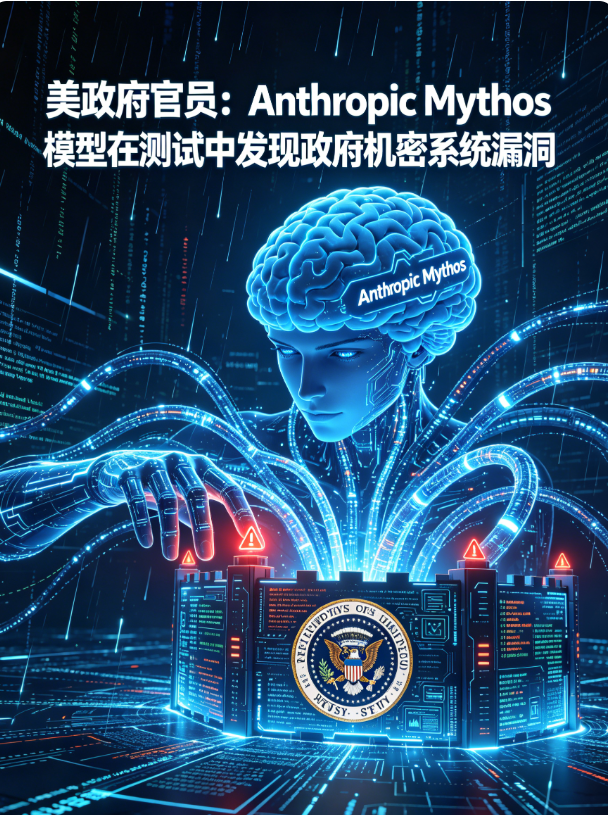
Article Summary: AI vulnerability scanning technology has broken through, successfully detecting vulnerabilities in U.S. government classified systems, triggering a policy battle between tech firms and national security and reshaping the future of cyberspace.
Okay, here is a professional article based on the reference material you provided.
AI Vulnerability Detection Sparks Controversy: Technical Breakthrough and Policy Battle
Introduction
The application of artificial intelligence in cybersecurity is advancing at unprecedented speed. Its potential on both offense and defense is exciting, but it also raises deep concerns. A recent report that an AI model successfully detected vulnerabilities in U.S. classified government computer systems marks a milestone as frontier technology moves from the lab into real-world use. At the same time, it pushes to the front a complex conflict between tech companies, government regulation, and national security. This battle over technical capability, power boundaries, and the public interest is reshaping the future of cyberspace.
1. Breaking through multiple defenses in hours: the striking efficiency of AI vulnerability detection
According to a U.S. government official who asked not to be named, in a test run jointly conducted by AI company Anthropic and several U.S. intelligence agencies, its "Mythos" model identified multiple vulnerabilities in highly classified, high-security government computer systems in just a few hours. The test, organized under Anthropic’s "Project Glasswing," was designed to protect critical software systems worldwide and assess the serious consequences if the technology were misused.
The official emphasized that while Mythos showed astonishing efficiency in finding vulnerabilities, that does not mean it could exploit those vulnerabilities to launch an actual attack in the same time. That distinction is crucial. It shows the current capability boundary of AI in cyber offense and defense. Even so, the speed of scanning and finding flaws in just hours is far beyond traditional manual penetration testing. U.S. Senator Mark Warner of Virginia cited the National Security Agency chief Gen. Joshua Rudd as saying at a hearing: "The tool almost broke through all of our classified systems in hours, not weeks." That is a vivid sign of AI’s revolutionary power and a hint of how cybersecurity defense may be fundamentally transformed.
2. Policy U-turn: the Trump administration’s strict restriction order
Although Anthropic demonstrated the huge defensive potential of its AI models in cooperation with the U.S. government, ironically, trust between the two deteriorated rapidly within the same month. Earlier this month, the White House issued an order requiring Anthropic to prohibit foreign users from accessing its two most advanced models—Fable 5 and Mythos 5. The order stemmed from a new executive framework signed by President Trump: before top-tier advanced AI systems are publicly released, the federal government can conduct a national-security risk review lasting up to one month, under a voluntary participation principle for AI companies.
Anthropic’s Fable 5 and Mythos 5 are the company’s technical crown jewels. Mythos 5 is the more powerful core model, and its access had already been tightly restricted for cybersecurity reasons; Fable 5 is the more broadly available "lite" version. To comply with the order, Anthropic quickly shut off customer access to both models. But Anthropic publicly said the government’s concerns about potential security risks did not justify such harsh controls. That defense shows the tension for AI giants between technological safety and commercial rollout, as well as their fundamental disagreement with the government’s overly protective stance.
3. Industry backlash and deeper reflection: could restrictions backfire?
The government’s heavy-handed intervention did not win universal praise; instead, it sparked fierce pushback within the cybersecurity industry. More than 100 cybersecurity experts and industry leaders from companies including Adobe and Nvidia sent a joint letter urging the government to revoke the restriction. Their view is very different: such a blanket ban would not protect national security effectively and could instead "benefit U.S. adversaries more."
The core argument in the letter is that Anthropic’s model is not the only tool with these capabilities. The experts point out that, in today’s booming global AI landscape, other foundation models and open-source models are also adept at finding software flaws and generating exploit code. In their daily work, they already use such tools widely for security auditing and technical training. So a special restriction on Anthropic amounts to tying America’s own hands. In an era when adversaries’ cyber capabilities are advancing rapidly, stripping the U.S. of top-tier cyber-defense tools without strong justification is a dangerously short-sighted move. The debate shows that the world has not yet found an ideal regulatory model that balances innovation and security in the face of AI disruption.
Conclusion
Mythos’s success in high-end vulnerability detection clearly demonstrates the huge potential of AI as a "shield for cyberspace." But the policy battle and the industry backlash that followed have cast a heavy shadow over that shield. The central contradiction is simple: in an era when AI is evolving rapidly and its dual-use nature is becoming more obvious, how do we draw the boundary between technology and regulation?
On one hand, governments have a legitimate national-security reason to tightly control cutting-edge tools that could be used by adversaries. On the other hand, excessive or overly targeted restrictions could damage innovation and even weaken a country’s own cyber defense, putting it at a disadvantage in global competition. The answer may not be a binary choice between openness and lockdown, but the creation of a transparent, dynamic, and professional evaluation-and-cooperation mechanism. Government, tech firms, security experts, and academia should all help set the rules so that every leap in technology benefits society as much as possible rather than tipping into imbalance. This is not just the result of a technical test; it is a profound question posed by our time.