
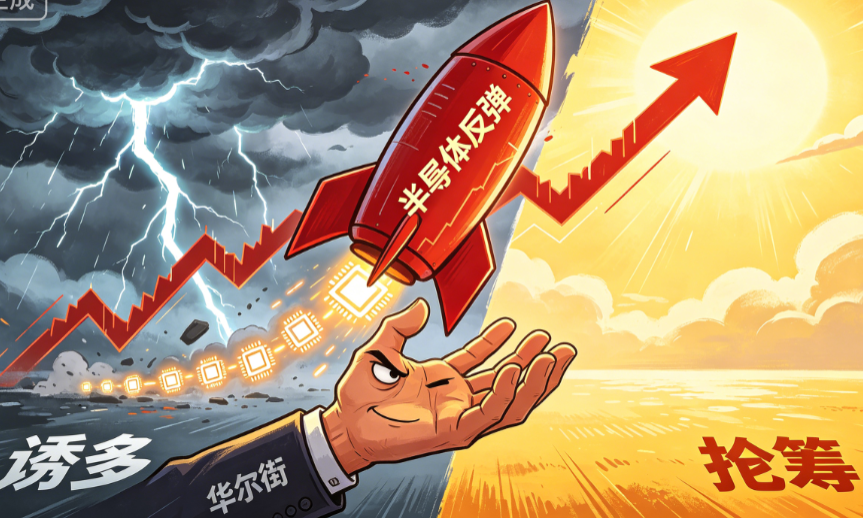
Article Summary: The semiconductor sector has staged a violent rebound, and many AI chip stocks have snapped back hard. This piece breaks down the causes of the rally, whether institutions are accumulating at the bottom or using the bounce to lure buyers, and lays out the signals for judging sustainability, sector divergence, and how ordinary investors should act.
Chip stocks recovered overnight, and the most dangerous thing may not be missing the move, but thinking the bull market is back. Yesterday the market was still saying the AI chip bubble had burst; today Micron, Marvell, AMD, and Nvidia were all dragged back onto the board by money. Retail investors just sold, while Wall Street looked like nothing happened and started buying. Is this really an opportunity, or is it a more advanced bait-and-switch? In today’s video, I’ll break down three things clearly: first, why semiconductors suddenly rebounded so violently; second, whether institutions are really buying the dip or using the rebound to distribute; and third, what signals ordinary investors should watch to tell whether this is a reversal, a repair, or a trap.
A chip stock bouncing back does not mean the risk is gone. What determines whether you get harvested is not how many points it rose today, but whether you can understand what Wall Street is really playing this time.
Don’t read this rebound as simply “all bad news is out,” and don’t assume a big rally means the AI bull market is fully back. It is more like a stress test after a big selloff. What really matters is not how many points it rose, but why money was willing to come back at this level, whether that money is long-term or short-term, and whether it is buying earnings certainty or just a rebound spread. In other words, last night’s rally does not prove the risk is gone; it only proves Wall Street has not abandoned the AI theme. Semiconductors are not unwanted; the market is re-screening who really has orders, who really has cash flow, and who is only supported by stories. The most dangerous thing for ordinary investors is treating a bounce as a reversal, and sentiment repair as fundamental improvement.
Why did this get amplified so suddenly by the market? Because the prior semiconductor selloff was too severe. Over the past period, AI chip stocks ran so hard that many people were no longer calculating what the companies were worth; they were calculating, “If I don’t get in now, will I miss out on life?” Nvidia talked AI, Micron talked HBM, Marvell talked custom chips, Broadcom talked AI networking and ASICs—almost every company could be linked to AI. At the most manic point, as long as you had a little AI next to your name, the stock could rocket. But the problem is, stock prices can run ahead of earnings; profits cannot always keep up. AI data centers are not just a slogan. They cost real money: buying GPUs, building server rooms, wiring power grids, buying memory, laying optical modules, and handling cooling. It’s like running a restaurant: long lines are great, but if you triple the rent, renovation, kitchen equipment, and staff costs just to serve those customers, the final profit still has to be checked on the books.
So the previous wave of selling was not because the market suddenly stopped believing in AI; it was because the market started asking a more realistic question: how much money will this AI story burn, and when will it pay back? For example, companies like Oracle look hot because cloud and AI demand are strong and orders look pretty, but once the market sees capex and negative free-cash-flow pressure, the mood changes immediately. The logic is simple: in the past, the market liked hearing “I’m increasing AI investment.” Now the market fears hearing “I’m increasing AI investment.” The same sentence was a positive last year and may be pressure this year. Investors have suddenly realized that AI is not free magic; it is more like a giant money-eating machine. To make it run, you have to keep feeding it cash.
Now look at this rebound: why did chip stocks recover overnight? One reason is that after such a deep selloff, short-term capital does need a repair trade. A stock is like a rubber ball; after being smashed too hard, a bounce is normal. Another reason is that the market has not seen AI demand truly collapse. The memory cycle behind names like Micron, especially HBM demand, still has strong support. Companies like Marvell, tied to custom chips and data-center infrastructure, are still inside the AI infrastructure chain. In other words, the market cut over-extended valuations; it did not cut the entire AI logic. That distinction is very important. It’s like having a fever: it does not mean the patient is beyond saving, but it also doesn’t mean a bit of fever relief means you can go run a marathon immediately.
Market reactions were interesting too. During the big down days, retail sentiment split into two extremes. Some people who had already made money rushed to lock in gains, thinking they should run first and not let profits ride the roller coaster. Others who had just bought at highs stared at a giant red candle and refreshed after-hours prices before bed. Then the rebound came, and the group chat tone changed instantly. Yesterday it was “AI is over,” and today it became “should we get back in?” That’s how the market torments people. It doesn’t just keep you in pain; it gives you a little sugar after the pain, so you can’t tell whether it’s an opportunity or a trap.
Institutional reactions are much less emotional. Wall Street won’t get pumped because of one big up day, and it won’t cry and leave because of one big down day. It watches position size, volume, options, capital flows, and the data window over the next few weeks. What retail sees is red and green; what institutions see is who is selling, who is buying, whether selling pressure has cleared, whether rebounds have volume, and whether stronger names recover first while weaker names are just riding the buzz. There is one very important signal: if the rebound is concentrated in the companies with the strongest earnings support and clearest order visibility—like memory, custom chips, and networking—then capital is selecting assets. If even junk names are all rising together, be careful; it may just be a dead-cat bounce in sentiment.
Next, let’s talk about the real logic behind it.Please like and subscribe, and let’s keep going.
————————
This semiconductor rally looks like a chip story on the surface, but there are really three lines underneath it. The first line is AI compute demand. As long as cloud vendors keep building data centers and large models keep upgrading, GPUs, HBM, switches, optical modules, and custom chips will still be needed. The second line is capex pressure. Demand is real, but spending is real too. Companies can say the future is wonderful, but investors now want to know whether current cash flow can hold up. The third line is rates and valuation. If Treasury yields go up and rate-cut expectations cool, high-valuation tech stocks suffer. Why? Because future profits are discounted back to today, and the higher the rate, the less those future dollars are worth today. That sounds complicated, but think of it like this: if someone says they’ll repay you $100 in five years, and rates are low now, that sounds okay; if rates are high now, you’ll ask, why not take the money now and buy bonds instead of waiting five years?
So whether this rebound can last does not depend on retail chanting “go go go,” and it does not depend on how pretty one day’s move looks. It depends on three questions: first, are AI orders still being realized? Second, are company guides being raised? Third, are market rates still suppressing valuations? As long as these three are not all improving at the same time, semiconductors won’t easily enter a phase where you can buy blindly and keep rising. Right now it looks more like a shift from broad-based rallies to sector divergence. In the past, the two letters AI alone could make stocks rise; now companies must prove they’re actually making money in the AI supply chain.
So what is Wall Street really doing—buying, exiting, baiting, or rotating? I lean toward one thing: it is re-ordering the seats. Not every chip stock is unwanted, and not every chip stock is worth chasing. Capital may be moving out of pure story stocks and into names with harder earnings, clearer orders, and steadier cash flow. For example, HBM represents the memory bottleneck in AI servers, custom chips represent cloud giants reducing dependence on a single GPU supplier, and networking represents how machines talk to each other at high speed inside data centers. These are not mysticism; they are real things AI infrastructure needs.
But the risk of a bait-and-switch cannot be ruled out either. Because after a big selloff, the first rebound is the easiest place to create an illusion. You think institutions are buying, but sometimes it’s just short covering. What is short covering? Simple: someone borrowed shares earlier and sold them, betting on a decline. Now that the stock has fallen, they have to buy it back to return it, and that buying pushes the price up. But those buys are not necessarily long-term bullish; they may just be closing a bet. So a strong-looking rebound does not mean the buyers are all long-term capital. What you need to watch is whether the stock can hold after the rebound, whether it can break out on volume, and whether earnings still support it.
The easiest places for ordinary investors to misread are, first, only looking at gains and losses, not the price location. A stock up 10% sounds exciting, but if it just fell 20% before that, it may only be moving from the ICU to a general ward, not being discharged. Second is looking only at the story, not the books. AI stories are sexy, but cash flow is the main course. A company may talk about the market size for the next ten years, but if every dollar of current profit costs three dollars of burn, the market will eventually ask whether this is a money machine or a money shredder. Third is looking only at positives, not at expectation gaps. Sometimes a company’s earnings are actually good, but the stock falls because the market already priced in an even better outcome. It’s like scoring 90 on an exam: in an ordinary class you’re a top student; in a genius class you may still be told it wasn’t amazing enough.
There is another very dangerous misconception: thinking “the leader is fine” means “all the smaller names are safe.” Nvidia being strong does not mean every AI chip stock can be strong. Micron has an HBM thesis, but that doesn’t mean every memory stock is a buy. Marvell has a custom-chip story, but that doesn’t mean any valuation is justified. That’s the cruel part of the market: the main theme can continue, but it keeps eliminating players within the theme. It’s like a commercial street being hot; that doesn’t mean every store makes money. Some have lines out the door, some can’t even cover rent.
So what should we watch next? I’ll give you a few signals that ordinary investors can track.Please like and subscribe if you’re following along, and I’ll keep going.First, watch earnings and guidance, especially whether companies raise future revenue expectations and whether AI-related business keeps accelerating. The exact numbers should always be based on the latest earnings and guidance, not old data. Second, watch CPI and the Fed. If inflation stays sticky, rate cuts get pushed back and high-valuation tech gets pressured. Third, watch the 10-year Treasury yield. It’s like the ceiling over tech stocks; the higher yields go, the harder it is for valuations to expand. Fourth, watch trading volume. A truly healthy rebound is not just price rising; it also needs capital willing to keep buying. Fifth, watch order quality and customer mix. In the AI supply chain, who has big cloud customers, who has long-term contracts, and whose demand is just short-term hype are differences that will matter more and more.
————————
If you’re an ordinary investor, I don’t recommend seeing one big green candle and immediately getting emotional. A more rational framework is to ask yourself three questions first. First, am I buying a short-term rebound or a long-term thesis? If it’s a short-term rebound, you have to admit the volatility is high, and not use a long-term story to comfort short-term losses. Second, can I tolerate further drawdown? If another 10% drop would keep you up at night, then your position is too big. Third, do I have clear watch signals? If you’re buying just because everyone else is shouting AI is back, then you’re not investing; you’re following the crowd mood.
For beginners, the best move may not be to rush in, but to first break the sector apart and understand it. AI chips are not one basket: there are GPUs, HBM, ASICs, networking switches, optical modules, wafer manufacturing, equipment, and materials. Different links have different elasticity and different risk. You don’t need to understand everything, but you should at least know what your company actually makes money from. Is it selling the shovel or digging the gold? Is it earning today’s money or future money? Are its customers concentrated? Is the valuation expensive? Is the cash flow stable? Those questions matter a lot more than how many points it rose today.
If you already have positions, the point is not to be scared by one day’s move, but to check whether what you own is a good asset, whether your position size is comfortable, and whether the thesis has changed. If you bought it as a short-term chase, don’t lie to yourself and call it a long-term investment. If it is a long-term core asset you truly believe in, don’t cut it wildly because of one or two days of volatility. The market loves to punish two kinds of people: those who realize they had no logic only after they fell, and those who realize they had no plan only after they rose. Mature investing is not about buying the exact bottom every time; it is about knowing why you bought, what you’ll do if you’re wrong, and how you’ll hold if you’re right.
Therefore, I want to tell everyone that this violent semiconductor rebound is not mainly telling you to buy immediately or sell immediately. It is reminding you that the AI rally has entered a harder stage. In the past, telling a story got applause; now, after the story, the market wants to see the bill. In the past, just standing next to AI could make stocks rise; now you must prove you can actually make money from AI. Wall Street is not a charity; it does not support the chair for retail investors for no reason. Whether it is buying, baiting, or rotating, there is always a calculation behind it.
So remember one sentence: a chip stock snapback does not mean risk is gone; Wall Street re-entering does not mean retail can go all-in blindly. The real opportunity is not in the loudest green candle, but in who can still produce orders, profits, and cash flow after the noise fades. When prices rise, don’t just look at the fireworks; look down at the bill. Because the market’s most expensive lesson is often not taught when it falls, but when the rebound makes you forget the risk—and then slams you with it again.
Alright, friends, that’s all for today’s video.If this episode helped you understand whether the semiconductor rebound was real buying or a bullish trap used to distribute stock, you can save it for later and don’t forget to like. You can also subscribe to the channel so you won’t miss future episodes. I’ll keep helping everyone decode the hidden investment clues and opportunities in the U.S. stock market under a complex environment. See you in the next video!