
Article Summary: Fed Chair Warsh chairs his first FOMC meeting, holds rates steady, downplays forward guidance and dot plot, reaffirms 2% inflation target, announces five special task forces to advance communication, data, and institutional reform.
Fed Chair Warsh's First Appearance: Downplays Dot Plot, Holds Firm on 2% Inflation Target
At 2:00 a.m. Beijing time on June 18, the Fed announced it would continue to keep the federal funds rate target range unchanged at 3.5% to 3.75%, marking the fourth consecutive hold this year, in line with market expectations.
The post-meeting statement showed officials believe inflation remains elevated and reiterated their commitment to achieving price stability; they also described economic growth as 'solid' and noted strong productivity and capital investment. The statement was more concise than previous ones, suggesting new Chair Warsh may be driving changes in communication style.
Policymakers made several revisions to the March economic forecasts: the median inflation forecast for this year was raised from 2.7% to 3.6%, the 2026 core inflation forecast from 2.7% to 3.3%; meanwhile, the median 2026 GDP growth forecast was lowered from 2.4% to 2.2%, and the median unemployment rate forecast for end-2026 was cut from 4.4% to 4.3%.
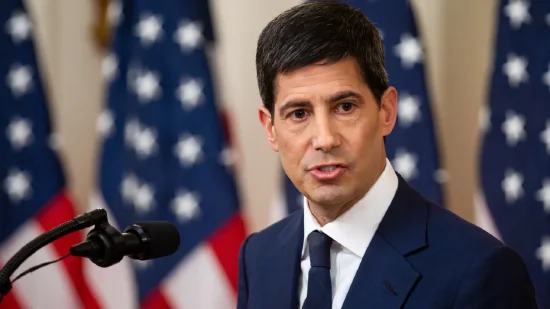
After his first policy meeting as chair, Warsh pledged to restore price stability. Earlier, Fed officials held rates steady and signaled support for a rate hike this year.
Warsh said at the press conference that persistently high prices are a burden on Americans, but the past does not necessarily determine the future, and the FOMC is committed to achieving price stability.
He also downplayed the significance of colleagues' latest rate forecasts. The dot plot shows 9 of 19 officials expect at least one rate hike this year, with 6 expecting at least two, and 9 expecting rates to remain unchanged or be cut. Warsh said other officials are also not confident in their forecasts, with many acknowledging high uncertainty about the economic outlook; when asked about the rate debate at this meeting, he said the committee had a 'healthy internal debate.'
As a longtime critic of forward guidance, Warsh made clear he would not submit rate forecasts.
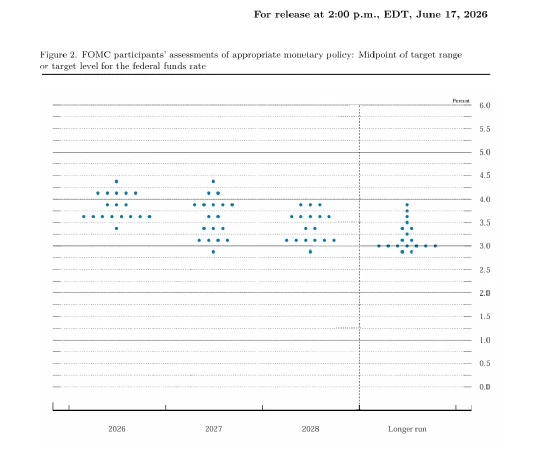
Regarding the dot plot, 18 of 19 officials submitted forecasts. Among them: 1 official believes the cumulative rate hike for the remainder of 2026 should be 75 basis points, 5 officials believe 50 basis points, 3 officials believe 25 basis points, 8 officials believe rates should remain unchanged, and 1 official believes a cumulative 25-basis-point cut is warranted.
Communication Framework Reshaping: Downplaying Forward Guidance and Dot Plot
Warsh used this press conference as the starting point for communication framework adjustments. He made clear that the Fed has abandoned forward guidance, deeming the tool no longer suitable for the current environment and unable to provide guidance on specific future actions.
He also said the dot plot has limited usefulness for policy execution and that the FOMC does not consider itself bound by rate projections; he himself did not provide a dot plot forecast this time. Regarding press conferences, Warsh acknowledged their communication value but said some adjustments are necessary in the future.
He said he would not be surprised if a new communication framework is disclosed by year-end.
Inflation Target and Response: Holding the 2% Line
On inflation, Warsh emphasized that the 2% inflation target remains the Fed's long-term goal and that there is no reason to reassess it until it is achieved. He said the Fed will continue to address the five-year deviation from the inflation target.
Regarding price volatility caused by supply shocks in energy and other sectors, Warsh said the Fed cannot significantly influence specific prices; its core task is to ensure there is no 'second-round price effect.' He also noted that most data currently relied upon by the Fed comes from outdated survey methods, which is an area for reform.
Five Special Task Forces to Advance Institutional Reform
To address current challenges, Warsh announced the formation of five special task forces covering monetary policy areas, with most work expected to be completed by year-end.
The communication task force will propose adjustments to the Summary of Economic Projections (SEP); the balance sheet task force will assess proper reserve duties; the data source task force will address data lag issues; the productivity task force will specifically examine AI's impact on productivity; and the employment task force will focus on labor market dynamics. A separate inflation task force will examine inflation drivers.
Independence and External Relations
Warsh stressed that the Fed will never delegate decision-making to any outsider, clearly defending central bank independence.
He revealed that he has had three breakfasts with Treasury Secretary Bessent so far, and has met with the Fed's Inspector General, who will issue a report this summer on the renovation of the Fed building.
On market pricing, Warsh said markets tend to perform best when reacting to real-time data, and market prices themselves may be the most important reference information.
Market Reaction: US Stocks Fall, Dollar Strengthens, Short-Term Bonds Drop
In response to the Fed's hawkish stance, US stocks fell on Wednesday, with the Dow dropping about 500 points, tech heavyweights leading declines, and Treasury yields surging as investors face greater uncertainty about the monetary policy path.
Closing data: Dow down 507.12 points, or 0.98%, to 51,492.55; Nasdaq down 354.68 points, or 1.34%, to 26,021.65; S&P 500 down 91.25 points, or 1.21%, to 7,420.
Oil prices edged higher after two days of steep declines, but the expected imminent signing of a temporary peace agreement between the US and Iran continues to pressure oil. WTI crude rose 1% to settle below $77 per barrel, while Brent crude settled below $80.
The dollar index posted its biggest gain in three months. USD/JPY rose 0.14% to 160.65 yen; GBP/USD fell 0.99% to 1.3293; EUR/USD fell 0.92% to 1.1501.
In US bond markets, short-term Treasury prices fell sharply, with the yield curve flattening dramatically. The 2-year Treasury yield rose as much as 15 basis points to 4.20%, the highest since February 2025.
Institutional Views: Hawkish Signals Strengthen Market Rate Hike Expectations
Natixis believes the meeting was generally hawkish: rates unchanged, easing bias removed with no dissenting votes, statement significantly streamlined, and ending with a commitment to achieve price stability.
Goldman Sachs Asset Management said the meeting confirmed that the Fed's recent hawkish shift is not solely driven by energy prices; half of the dot plot members expect a rate hike as early as this year, reflecting strong labor market and inflation data. Its base case remains that the Fed can barely avoid a rate hike, but the path is narrow, making subsequent inflation data extremely critical.
'Fed whisperer' Nick Timiraos said the dot plot shows a clear hawkish tilt, and the policy statement has been fully revised from start to finish with a noticeable reduction in length. The communication framework could change significantly as a result, and market expectations for the rate path may be recalibrated.
Editor: Ding Wenwu