
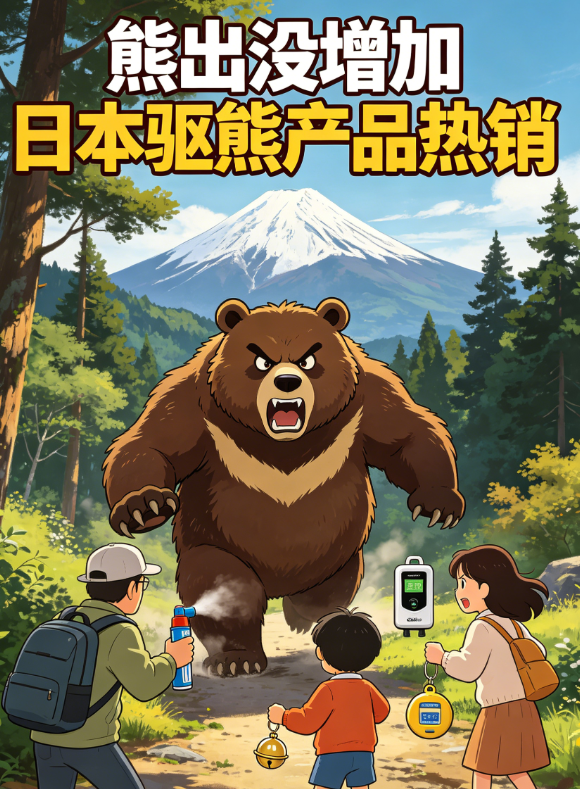
Article Summary: Frequent bear attacks in Japan have spurred a bear-repellent industry. From high-concentration pepper spray and bear sticks to AI alert systems, high-tech products are selling fast. This article examines the industry’s current state, technical features, and the role and limits of technology in managing human-bear conflict.
Sure, here is a professional and formal article written to your requirements.
Rising Human-Bear Conflict Spurs Bear-Repellent Industry: Tech Responses from Pepper Spray to AI Alerts
Keywords: Japan bear attacks; bear-repellent products; AI alerts; bear defense gear; human-bear conflict
Introduction
In recent years, bear activity has become increasingly frequent across Japan, and encounters between humans and bears have surged, posing serious challenges to daily life and public safety. According to the latest data from Japan’s Ministry of the Environment, there were 1,759 bear sightings nationwide in April alone this year—the highest monthly figure since records began in fiscal 2009, more than double the level of the same period last year. Even more alarming, 19 people were attacked by bears between April and May, and 4 died. Faced with the growing “bear problem,” Japanese companies have quickly seized market demand and launched a range of high-tech bear-repellent products—from concentrated pepper spray and telescopic bear sticks to AI-based alert systems. Despite their high prices, these products are selling rapidly. This article examines the current state, technical features, and social significance of this emerging industry, and explores the role and limits of technology in managing human-bear conflict.
1. Bear Spray: A “Customized” Upgrade to a Chemical Barrier
As one of the most traditional bear-deterrence tools, spray products have undergone technological upgrades and more precise positioning in recent years. A Tokushima-based animal medicine manufacturer, working with biologists, has launched a new bear spray priced at 9,900 yen (about 416 RMB). With capsaicin content above 2%, the spray strongly irritates a bear’s eyes, nose, and lungs, effectively preventing it from approaching. It can spray continuously for about 10 seconds, with a maximum range of 10 meters, giving users a relatively safe buffer zone.
Notably, this spray was not developed only for hikers or outdoor workers. According to the company, before launch it received inquiries from construction workers, civil engineering firms, couriers, and convenience store staff. These groups often work near bear habitats but previously lacked professional, easy-to-use protection. A company spokesperson said, “We hope this spray can keep bears and humans at a proper distance—protecting people while avoiding permanent harm to bears.” This idea of “moderate deterrence” reflects Japan’s growing emphasis on ecological balance and animal welfare in responding to human-bear conflict.
2. Bear Sticks: From Personal Trauma to Innovation
If bear spray is “passive defense,” bear sticks emphasize “active blocking.” The experience of Sato Masashi (phonetic transcription) is typical. He originally ran an online pet-supplies store, but after being bitten by a bear during an outdoor activity, he became determined to develop a lightweight tool that could keep users away from bears in emergencies. He successfully obtained a patent and launched a bear stick made of aluminum alloy and stainless steel.
The product is available in seven models, priced from 12,000 to 27,000 yen (about 504 to 1,135 RMB). Each has a retractable fork-shaped tip. Users can adjust its length with the telescopic body and, when encountering a bear, use the fork structure to block it at a certain distance and gain time to escape or call for help. Sato said, “We’ve been getting a lot of attention lately, orders keep coming in, and we’re producing at full speed. We’ve even received inquiries from local governments, but demand is so high that capacity is struggling to keep up.” This simple yet practical design precisely addresses emergency needs for ordinary people without professional protection and reflects Japan’s urgent demand for affordable self-defense tools.
3. Sound-and-Light Bear Deterrent: A Non-Contact, All-Weather Solution
To address the problem that traditional spray may fail in bad weather, a pest-control company in Gifu Prefecture has launched a bear deterrent device priced at 198,000 yen (about 8,323 RMB). Shaped like a megaphone, it has a high-power speaker that can emit 40 different high-frequency sounds at more than 120 decibels. It also has a powerful flash unit to drive bears away through the combined effects of light and sound.
Company representative Ono Saki (phonetic transcription) explained: “When using bear spray, strong wind can blow it back onto the user. With this device, you simply aim it at the bear and press the button. It works with light and sound, so it can be used normally even in rain or strong wind.” This contact-free method without chemical residue is especially suitable for complex weather conditions and avoids secondary pollution or accidental exposure to the user.
4. AI Alert Systems: From Passive Defense to Active Monitoring
A more forward-looking solution comes from the integration of AI. The same company has also launched an alert system combining surveillance cameras and AI recognition technology, which can be installed at parking lots, factory entrances, and the edges of residential areas. The system can detect bears at up to 110 meters in the daytime and 80 meters at night. Once the camera captures a bear, the AI immediately analyzes image features, confirms the sighting, and sends an alarm to the backend so staff can evacuate people or drive the bear away. The monthly rental fee is 40,000 yen (about 1,681 RMB), a manageable cost for businesses or communities, in exchange for 24/7 electronic sentry-style protection.
The core advantage of this system is “anticipation”: it does not wait for a direct encounter, but gives people a chance to avoid risk early through advance warning. According to The Japan Times, although next-generation bear-repellent tools are not cheap, they may soon be seen as “worth the price.” A fishing enthusiast who saw a bear last month, Miyamae, said, “It feels like bear encounters are becoming more and more frequent, so we need to be better prepared.” This captures the feelings of many Japanese people.
5. The Social Landscape Behind Market Demand
The popularity of bear-repellent products is not an isolated technological phenomenon; it reflects the intensifying human-bear conflict in Japan. In recent years, bear habitats have been squeezed by urbanization and forestry development, while bear populations have recovered in some areas, sharply increasing the frequency of bears entering human living spaces. April’s data—1,759 sightings and 19 attacks—are only the tip of the iceberg. In this context, bear-repellent products have shifted from niche outdoor gear to everyday necessities, with prices ranging from a few hundred yen to nearly 200,000 yen, serving different consumer groups.
But can technology alone fundamentally ease human-bear conflict? Experts point out that deterrent devices, sprays, and AI alerts can reduce short-term risk, but in the long run the solution must start at the ecological level, including restoring natural bear habitats, creating buffer zones, strengthening public education, and implementing scientific population management. Otherwise, more bear-repellent products may only hide the root cause of the problem.
Conclusion: The Challenge of Coexistence Empowered by Technology
From high-concentration pepper spray to telescopic bear sticks, from 120-decibel sound-and-light deterrents to AI-powered alert systems, the rapid evolution of Japan’s bear-repellent industry shows the huge potential of technology in responding to sudden public-safety threats. These products protect human lives while, to some extent, avoiding indiscriminate harm to bears. Yet technology is only a stopgap. True human-bear coexistence requires governments, research institutions, communities, and the public to work together: improving emergency protection while placing greater emphasis on ecological restoration and preventive management. As the inventor of the bear stick, Sato, said after being bitten by a bear, “We are not trying to hurt bears; we want both humans and bears to live safely.” That may be the industry’s simplest original intention—and the bottom line for future human-bear conflict management.
Word count: about 1,580 words (including title, keywords, subheads, and body)