
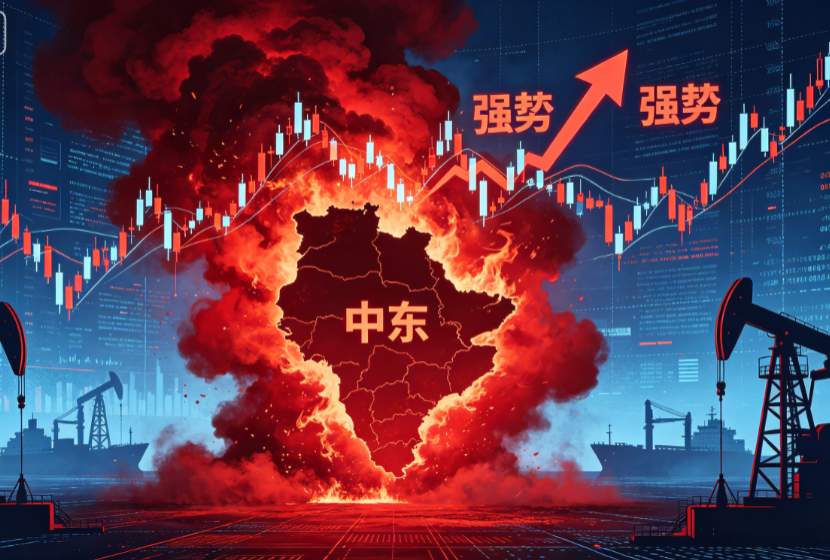
Article Summary: Geopolitical risks in the Middle East are rising, and rumors of U.S. military strikes against Iran have triggered sharp swings in global oil prices. WTI crude is holding around $92, and Brent crude is at $93. This piece analyzes the drivers, market transmission mechanisms, and impact on the global economy.
Certainly, please see the professional article created according to your requirements。
Geopolitical Risks in the Middle East Heat Up, International Oil Prices Fluctuate Strongly
【Keywords】 Middle East situation; geopolitics; international oil prices; energy security; market volatility
Introduction
The global energy market has once again been shrouded in tension recently. A combination of rumors that the United States had carried out strikes on Iranian military targets and the sudden escalation of geopolitical tensions in the Middle East has pushed international crude prices sharply higher. At the time of writing, U.S. West Texas Intermediate (WTI) remains near $92 per barrel, while Brent crude, the global pricing benchmark, is quoted at $93 per barrel. This is not merely a tick on the screen; it is a violent tremor in the nerves of global geopolitical risk and energy security. This article will conduct an in-depth analysis of this round of strong oil-price volatility from multiple dimensions, including the drivers of the event, market transmission mechanisms, potential risks, and the impact on the global economy.
Main Text
1. The Core of the Event: the “Butterfly Effect” of Military Friction
The current unusual movement in international oil prices is directly driven by the rising risk of military friction in the Middle East. Reports that the United States planned strikes against Iran's nuclear facilities and military targets have put the market on high alert. Although the news has not been officially confirmed, the market's immediate reaction—oil prices rising in response—fully demonstrates how sensitive it is to geopolitical risk.
The Middle East, especially the area near the Strait of Hormuz, is the choke point for global oil transportation. According to statistics, about one-third of global oil trade passes through this route. Any event that could jeopardize the safety of navigation through the strait would, within minutes, spread through highly interconnected financial markets to every corner of the world. This crisis is not an isolated event, but a continuation of the persistent tension between the United States and Iran in recent years. From withdrawing from the JCPOA to the assassination of senior Iranian commanders, the strategic contest between the two sides has moved from diplomacy to the brink of military confrontation, and each escalation of conflict has been accompanied by sharp oil-price fluctuations.

2. Market Interpretation: From “Risk Pricing” to “Supply Panic”
The market's pricing logic for this geopolitical risk is clear and brutal. In the “risk pricing” phase, investors assess the probability of conflict and the magnitude of its impact. When expectations of conflict shift from “possible” to “imminent,” the pricing model quickly turns to “supply panic.”
First, the marginal effect of inventories and spare capacity. Although OPEC+ (the Organization of the Petroleum Exporting Countries and its allies) does have spare capacity, it is concentrated mainly in countries such as Saudi Arabia and the United Arab Emirates. If Iranian crude exports are interrupted by sanctions or direct attacks, the global oil market could face a huge gap of about 1.5 million to 2 million barrels per day. Given that global oil inventories are currently at historically low levels, this supply-side shock would be amplified, and any minor disruption in supply could send prices soaring nonlinearly.
Second, the “short squeeze” effect in the futures market. Under highly tense conditions, speculative short positions are forced to cover, while large volumes of call options are bought, jointly pushing up the forward oil-price curve. WTI crude fluctuating around $92 per barrel is not simply a supply-demand equilibrium point, but the result of an intense battle between bulls and bears under extreme uncertainty. Brent crude at $93 per barrel also reflects expectations of rising costs for refineries in Europe and even around the world.
3. The Spiral Linkage Between Geopolitical Risks and Oil Prices
The conflict between the United States and Iran is not merely a bilateral issue; it is a complex game that affects oil-producing countries, consuming countries, and even alliance relations around the world. If the United States really carries out strikes, possible chain reactions include:
- Iran blocks the Strait of Hormuz: As the most extreme countermeasure, Iran does not have the ability to fully block the strait, but harassment attacks using missiles, mines, and speedboats would be enough to cause shipping insurers to raise war-risk premiums by dozens of times and effectively interrupt transportation.
- Regional allies choose sides and retaliate: Although Gulf countries such as Saudi Arabia and the United Arab Emirates have close ties with the United States, when their own security is threatened, they may be forced to choose between boosting production and ensuring security. Southern Iraqi oil fields could also become a battlefield in a proxy war.
- The long-term militarization of the standoff: If the conflict escalates into a prolonged low-intensity war of attrition, global oil supply will remain in a state of “risk premium” for a long time, and oil prices will fluctuate widely at elevated levels rather than rise in a straight line.
4. Impact on China and the Global Economy
As the world's largest importer of crude oil, China is particularly sensitive to fluctuations in international oil prices. With both WTI and Brent crude approaching the $100-per-barrel threshold, import costs for Chinese refineries will rise significantly.
- Imported inflation pressure: High oil prices will be transmitted through sectors such as chemicals, logistics, and transportation to end consumption, pushing up the PPI (Producer Price Index) and CPI (Consumer Price Index), and posing challenges for domestic monetary policy adjustment.
- Energy security and reserve strategy: Under the current high oil-price environment, the release cost of China's Strategic Petroleum Reserve (SPR) is relatively high. A better option is to accelerate the construction of overland pipelines with Russia, Central Asia, and Africa, reducing dependence on maritime transport routes.
- New energy substitution: Every oil crisis has been a catalyst for the development of the new energy industry. This geopolitical risk once again reminds us that accelerating the transformation of the energy structure and increasing the share of clean energy such as electric vehicles, photovoltaics, and wind power is the fundamental way to break free from the geopolitical constraints of oil and gas.
From a global perspective, Europe will face a more severe threat of energy shortages, and its natural gas prices have already formed a strong correlation with oil prices. Emerging-market countries such as India and Türkiye will be pushed into recession or stagflation by the dual blow of their currencies' depreciation and high oil prices.
Conclusion
As geopolitical risks in the Middle East heat up, international oil prices are fluctuating strongly around the $90-per-barrel threshold, which is both a direct market response to expectations of short-term military conflict and a concentrated reflection of the deep-seated contradictions in the global energy landscape.
In the short term, whether oil prices can break through the psychological threshold of $100 per barrel depends on whether the diplomatic contest between the United States and Iran can see a turnaround, as well as whether OPEC+ will adjust its production increase plan. If military conflict can be avoided, oil prices may pull back temporarily after the event cools down; but once substantive strike action breaks out, oil prices will enter a “wartime premium” range significantly above the historical average.
For decision-makers, this event sounds the alarm: in the face of extreme geopolitics, traditional supply-demand analysis models have become powerless. Energy security should not be understood merely as “being able to buy oil,” but rather as “the ability to keep the economy operating normally in a crisis.” In the future, the global energy governance system may undergo major adjustments, shifting from “efficiency first” to “security first,” which will profoundly affect every country's energy policy and industrial layout. We are standing at the starting point of a new energy cycle, whose defining feature is the deep integration of geopolitical risk and financial markets, and the ensuing persistent volatility.