
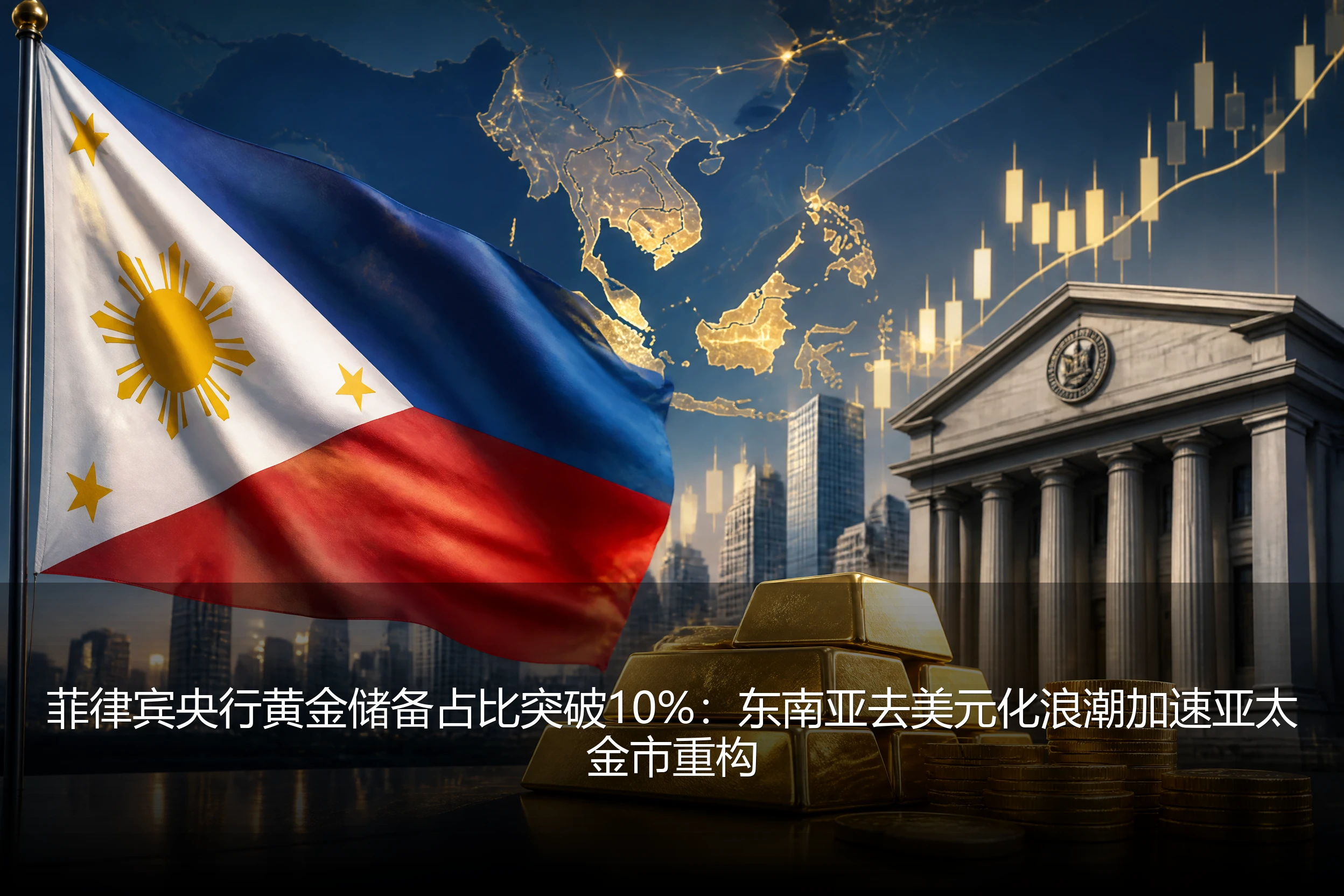
Article Summary: Latest data from the Bangko Sentral ng Pilipinas shows that its gold reserves now account for over 10% of total foreign exchange reserves, first surpassing the 10% threshold to reach 10.2%. This move signals the acceleration of reserve diversification strategies in Southeast Asian countries following the US Fed's interest rate cut cycle, adding new momentum to the trend of de-dollarization in the Asia-Pacific region. This article provides an in-depth analysis of the policy logic behind the Phili
As expectations for a shift in US monetary policy are rising, the central bank of the Philippines, one of the largest economies in Southeast Asia, is quietly accelerating its asset allocation strategy. According to the latest foreign exchange reserve composition report released by the Bangko Sentral ng Pilipinas (BSP) on August 3, 2026, as of the end of July, the total value of gold reserves held by the central bank has climbed to approximately $11.23 billion, surpassing the 10% integer threshold of its total foreign exchange reserves, reaching 10.2%. This data not only sets a new historical record for the central bank of the Philippines but also makes it the second country in the Southeast Asian region, after Thailand, to have a gold reserve ratio exceeding two digits, adding a significant note to the narrative of de-dollarization in the Asia-Pacific gold market.
Ten Years to Sharpen a Sword: The Philippines Central Bank's Gradual Increase in Holdings Path
Looking back at historical data, the Philippines central bank's gold reserve ratio was less than 3% in 2016, and this ratio began to steadily climb after the outbreak of the COVID-19 pandemic in 2020. In 2023, this ratio first surpassed 7%, and this time it jumped to 10.2%, indicating an acceleration in the rate of accumulation. It is noteworthy that the Philippines central bank's increase in holdings was not completed through a large-scale one-time purchase, but rather through a "gradual flow" strategy—from early 2025 to now, the central bank has continuously procured gold from local producers and actively participated in over-the-counter international market transactions. The advantage of this strategy is that it avoids causing drastic market fluctuations while achieving a sustained outflow of US dollar assets in the medium to long term. Governor Lim Romero previously stated multiple times that against the backdrop of escalating geopolitical risks and continuous inflation in major reserve currencies, gold as a non-sovereign risk asset has irreplaceable allocation value. This milestone of surpassing 10% in the ratio is a concrete manifestation of this philosophy in practice.
The Southeast Asian De-dollarization Wave: Commonalities and Differences
The action of the Philippines central bank is not an isolated event but a microcosm of the collective behavior of central banks in Southeast Asia and the Asia-Pacific region. Looking at the gold purchasing trends in the Asia-Pacific region during the first half of 2026, central banks in the Asia-Pacific region exhibit three significant characteristics:
Coverage is Broad: From Japan and South Korea in East Asia, to Thailand and the Philippines in Southeast Asia, and India in South Asia, almost all major economies are covered. Previously, the Bank of Japan had increased its gold reserve ratio to 5%, and the Bank of Thailand had clearly set a target of 8% for gold reserves, while the Bank of India continued to buy gold, recording a record of 20 tons in July 2025.
Acceleration of Holdings: Compared to 2024, the pace of gold buying by central banks in the Asia-Pacific region has clearly accelerated in 2026. Data from the World Gold Council shows that the total volume of gold purchases by Asia-Pacific central banks increased by over 35% year-on-year in the second quarter of 2026, with the contribution rate from Southeast Asian countries rising from 12% in 2024 to 18%.
Strategy-Driven: Unlike purchasing behavior based on short-term hedging or speculative demands, the core driving force of this wave of accumulation is the long-term expectation of structural changes in the international monetary system. Central banks in various countries generally hope to offset potential fluctuations in the dollar credit system and the risk of declining returns on dollar assets brought about by the US Federal Reserve's interest rate cut cycle by increasing their gold reserve ratios. From a macro perspective, the collective actions of central banks in Southeast Asian countries are having a profound impact on the supply and demand structure of the global gold market. Industry analysts estimate that if central banks in Southeast Asian countries increase their gold reserves to over 10%, this alone would generate an additional demand for over 300 tons of gold, equivalent to about 8% of global gold production.
Gold Price Impact: Structural Demand Supports High Price Levels
Following the announcement that the Philippine central bank's gold reserves have exceeded 10%, the Asia-Pacific gold market reacted positively. During the Asian trading session on August 4th, international spot gold prices gained slightly, finding support near $2750 per ounce, trading in the range of $2765 to $2778. Market analysts point out that this news further strengthens the structural support below gold prices. A precious metals strategist at a major Singaporean bank stated in an interview: "Central bank gold buying is characterized by its long-term and sustained nature, which differs from the short-term capital flows of ETFs. Once this demand establishes a trend, it will provide solid fundamental support for gold prices for several years or even longer." The strategist further predicted that if the demonstration effect of the Philippine central bank spreads to other small and medium economies in Southeast Asia, the gold price is expected to remain in the higher range of $2600 to $2900 per ounce throughout 2026. However, analysts remind investors to pay attention to the marginal changes in central bank gold buying rhythm. If the pace of US Fed interest rate cuts falls short of expectations, or if the dollar index experiences a phased rebound, it is not to exclude the possibility that some central banks may slow down their accumulation pace, triggering short-term profit-taking pressure in the market.
Southeast Asian Gold Chain: Opportunities and Challenges Coexist
Another important background for the Philippine central bank increasing its gold reserves is that the country itself possesses certain gold production capacity. The Philippines is one of the important gold-producing countries in the Southeast Asian region, with an estimated gold output of about 21 tons in 2025. By procuring gold from local mining companies, the central bank can both support the development of the domestic gold industry and reduce dependence on foreign exchange markets, achieving a "two birds with one stone" policy effect. However, the development of the Southeast Asian gold market still faces many challenges. On one hand, the basic facilities for gold trading in the region are relatively weak, lacking pricing centers with regional influence. On the other hand, there are significant differences in gold import/export policies and tax systems among countries, which increases the difficulty of cross-border arbitrage and logistics distribution. The new regulation proposed by the Indonesian central bank to mandate gold export processing and value-added is an attempt to enhance the value of the domestic gold industry from a policy level. Looking to the future, as central bank gold reserves in countries like the Philippines, Thailand, and Indonesia continue to grow, the region's voice in the global gold market will gradually increase. Some market observers predict that in the next 3 to 5 years, Singapore or Bangkok may develop into new gold trading hubs in the Asia-Pacific region after Shanghai, completely changing the current system dominated by London and New York in setting global gold prices. For investors, the continuous unfolding of the Asia-Pacific central bank gold buying trend signifies a further prominence of long-term allocation value in gold. Strategically, it is recommended to focus on opportunities to buy low when gold prices pull back to key support levels, while closely tracking changes in gold holdings in central bank quarterly reports as an important reference for judging the medium-term trend of gold prices.