
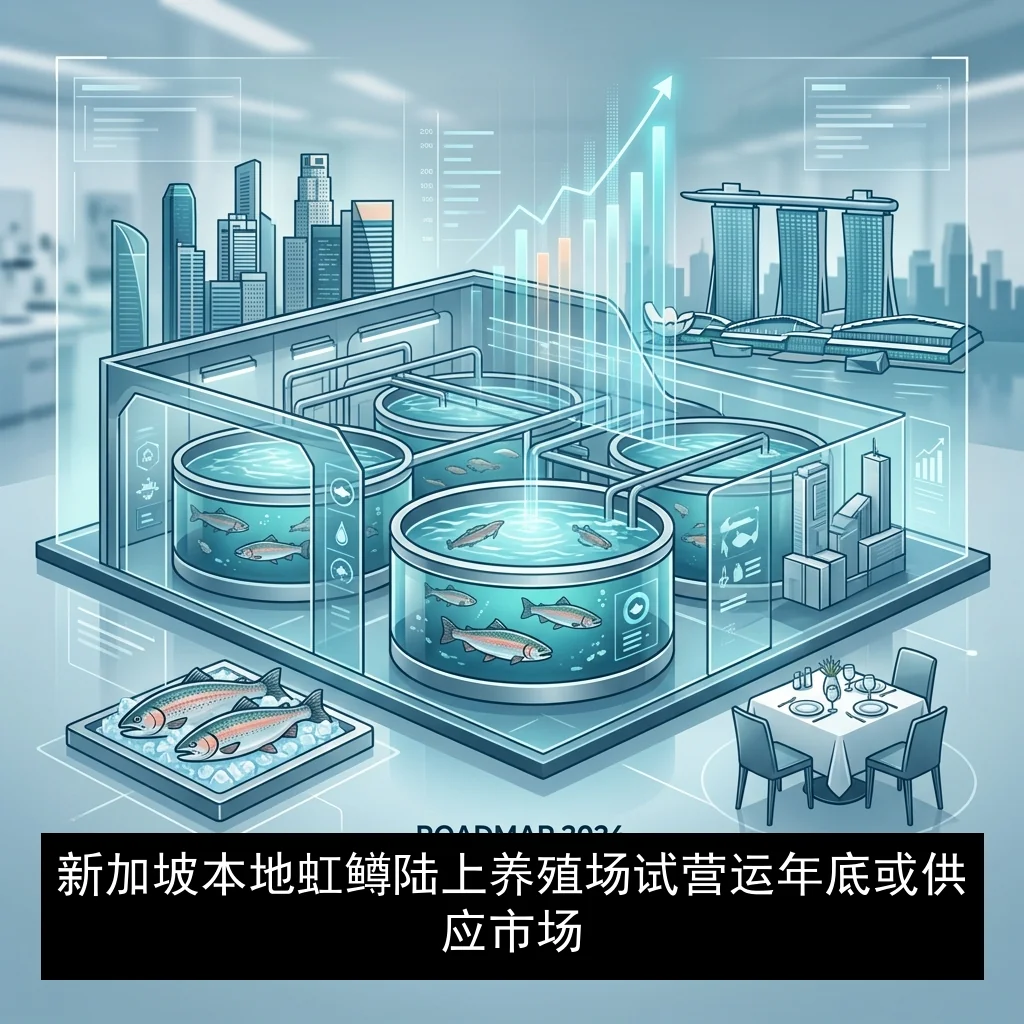
Article Summary: Singapore's first land-based rainbow trout farm starts trial operation; Blue Aqua uses RAS system for temperature and quality control. Initial annual output about 1,200 metric tons, potentially supplying market by year-end.
Singapore Local Rainbow Trout Land-Based Farm Trials, May Supply Market by Year-End
Singapore's first rainbow trout farm has started trial operations, and locally farmed rainbow trout could be on the table as early as year-end.
Local aquaculture player Blue Aqua held a launch ceremony at its rainbow trout farm in Lim Chu Kang Liang Zhuo Feng Shou Lane, announcing a phased capacity expansion. The farm's initial annual production is expected to reach 1,200 metric tons, with potential to increase to 3,000 metric tons in the future.
The 1.6-hectare land-based farm cost about S$45 million. Since rainbow trout are cold-water fish with strict requirements for water temperature, quality, and growth environment, the operator uses an advanced Recirculating Aquaculture System (RAS) with fully enclosed environmental control technology to precisely regulate temperature, water quality, and biosecurity in Singapore's tropical climate.
On the day of the visit, the farm's infrastructure was largely complete, but the rearing tanks had not yet been filled with water. Blue Aqua founder Farshad Shishehchian revealed that the company has prepared fish eggs and expects to cultivate adult fish weighing about 500 grams in approximately 8 to 10 months.
Farshad said the company hopes to start producing rainbow trout by year-end to test market response; the first batch of domestically farmed rainbow trout is expected to weigh between 350 and 400 grams.
As for the first batch yield, Farshad admitted it is still difficult to predict accurately. "We need extensive tuning and optimization. The results could far exceed expectations or fall short; essentially it is a process of constant calibration and improvement."

Founded in 2009, Blue Aqua also operates a shrimp farm in the same area with an annual output of about 120 metric tons. Farshad noted that rainbow trout and shrimp are different species with different farming challenges and advantages. Although the initial capital investment for rainbow trout farming is higher, the highly automated system combined with AI management technology makes overall operations easier to manage precisely.
Regarding the gradual increase in annual production, Farshad emphasized that this is not an ordinary automated farm but a fully controlled farming system. "Our data is very precise because all planning is calculated and designed based on actual capacity."
According to data released by the Singapore Food Agency in May, local farms produced 3,800 metric tons of seafood last year, an increase of 8.6% from 3,500 metric tons the previous year, but only accounting for about 2.7% of national seafood supply. Meanwhile, seafood imports increased from 124,600 metric tons to 138,000 metric tons, highlighting the country's high dependence on imported food.
Number of Local Farms Declines for Five Consecutive Years
Overall, the operating environment for local farms remains difficult, with the number of farms declining for five consecutive years. Official data shows the number of sea-based farms has shrunk since 2022, from 109 to 67 last year; land-based farms have been relatively stable, with 34 as of 2024.
Blue Ocean Aquaculture Technology also operates a land-based indoor fish farm. Managing director Huang Yisheng previously told the media that indoor farms inherently have higher operating costs, and if they cannot achieve a break-even over the long term, they will eventually be eliminated by the market.
Farshad admitted the company has experienced many failures and lessons, and will learn from them to avoid repeating mistakes. "We don't want another failure case," he said. The company has carefully calculated cost-effectiveness and is confident that the price of locally farmed rainbow trout will be lower than imported ones, enhancing market competitiveness.