
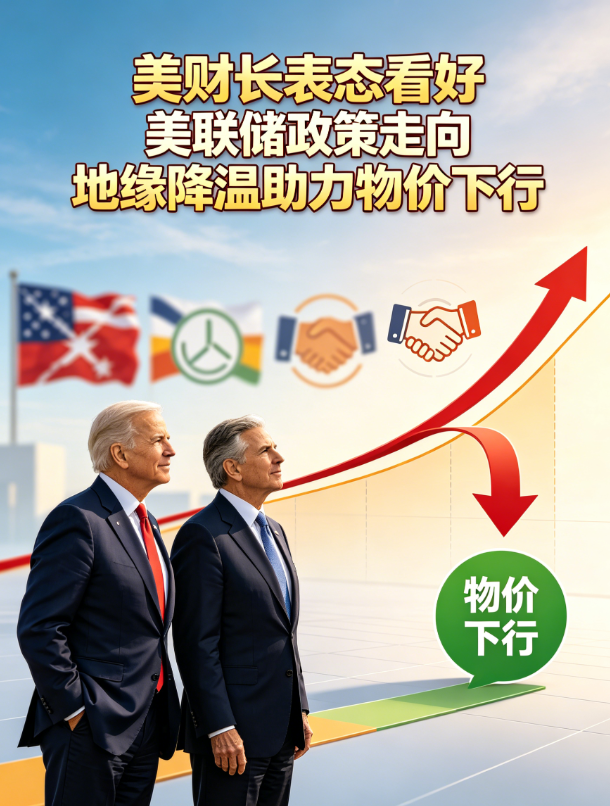
Article Summary: U.S. Treasury Secretary Bessent spoke at the New York Economic Club, laying out his views on Fed independence, the inflation outlook, and principles of economic diplomacy. He backed new Fed Chair Warsh and revealed a key shift in the Trump administration’s economic governance.
Bessent on the Fed’s New Phase: Monetary Independence, Inflation Outlook, and a New U.S. Economic Diplomacy Mindset
Introduction
On Tuesday local time, U.S. Treasury Secretary Bessent spoke and took questions at the New York Economic Club, offering a series of important views on the core issues of U.S. economic policy—Fed independence, the inflation outlook, and economic diplomacy. The speech not only made clear the Trump administration’s support for new Fed Chair Kevin Warsh, but also revealed the strategic thinking guiding U.S. economic decision-making as global geopolitics evolves. In effect, Bessent’s remarks reflect a key shift in Trump’s second-term economic governance: while maintaining political control, the administration seeks to contain inflation expectations through diplomatic easing and redefine America’s global leadership role under an economic-security framework.
Confidence in the new Fed chair: an independence pledge and policy reality
Bessent made his trust in new Fed Chair Kevin Warsh explicit. He said, "I believe the Fed chair will optimize the policy path for inflation and growth." That matters because Warsh took office under sustained political pressure from Trump to cut rates. But Bessent stressed that Trump publicly said at Warsh’s swearing-in that he would respect the Fed’s independence.
Last week, Warsh chaired his first post-appointment policy meeting. Despite continued calls from the White House for cuts, Warsh and other Fed officials voted unanimously to keep rates unchanged. Notably, new inflation data has made policymakers less focused on cutting rates; more of them now think there is a case for raising borrowing costs in 2026. That is a sharp contrast with Trump’s expectations.
This highlights the core contradiction of Fed independence: political cycles and economic cycles are naturally out of sync. Trump needs lower rates to spur short-term growth and strengthen political capital, but the Fed must stay alert to inflation. Bessent’s remarks are essentially a buffer for that tension: they acknowledge the Fed’s decision-making authority while implying that the president understands how economic rules constrain political prospects.
Bessent quoted a striking line: "Trump understands that governments overthrown by bond markets outnumber those overthrown by artillery." The point is the political cost of rising long-term borrowing costs driven by inflation. High inflation not only erodes consumer purchasing power; it also pushes bond yields higher, which feeds into government borrowing costs and ultimately weakens fiscal space and political legitimacy. That is why Bessent said, "I believe he has confidence that the Fed chair will make the right decisions."
Rather than simply praising Warsh, this is really market management—telling investors that even under political pressure, monetary policy will still be guided by fundamentals.
Inflation outlook: the link between diplomacy and the economy
Bessent’s inflation forecast was equally notable. He said that as U.S. and Iranian negotiators work to end the Iran war, U.S. consumer price increases are likely to slow. "At this point, I think we have moved beyond this conflict. Gasoline prices will come down, and inflation will return to target," he said.
The core logic is the strong relationship between energy prices and inflation. Tension in the Middle East often pushes crude higher, which lifts gasoline prices and becomes a major driver of inflation. If U.S.-Iran relations improve, global oil-supply uncertainty would fall sharply, and lower oil prices would help cool inflation.
Bessent also said that the 60-day license issued for Iranian oil sales is "good for global markets overall" and part of the negotiation process with Iran. This use of economic leverage reflects a pragmatic turn in U.S. foreign policy: easing some sanctions to create room for talks, reducing economic pressure, and creating conditions for a political settlement.
On the day of Bessent’s speech, the U.S. Senate passed a bill limiting presidential war powers and requiring Trump to end military action against Iran. It was the Senate’s first such bill since U.S. and Israeli military action against Iran began. The long-term impact is still unclear, but it reflects growing fatigue in the U.S. over continued conflict and a stronger political appetite for diplomacy.
If inflation does ease because oil prices fall, the Fed will have room to cut rates. For the Trump administration, that would be a dream political tailwind: it would ease public anger over living costs and create a more favorable economic backdrop ahead of the 2026 midterms. In that sense, Bessent’s inflation forecast is really a confidence boost for the entire executive branch’s economic agenda.
The core principle of economic diplomacy: from Hamilton to new industrial strategy
Bessent also laid out the principles of U.S. economic diplomacy, tracing them back to the first Treasury Secretary, Alexander Hamilton, who said each nation should strive to have within itself everything essential for national supply. In modern terms, that means economic security must rest on a domestically controllable industrial base.
Bessent said clearly that economic security begins with the ability to build, invent, finance, and develop the industries that will define the next century. He listed strategic sectors: semiconductors, artificial intelligence, quantum computing, advanced manufacturing, shipbuilding, critical minerals, and pharmaceuticals. He stressed that these industries are not only economic sectors, but sources of national power. The United States, he argued, must lead in all of them.
This shows a deeper shift in U.S. economic policy: from emphasizing global division of labor and free trade to a strategy centered on national competition and security. In Bessent’s framework, economic diplomacy is no longer just about opening markets and promoting exports; it is a key tool for national security, technological dominance, and supply-chain control.
This thinking directly echoes the U.S. government’s recent "de-risking" approach toward China. By treating key industries as sources of national power, the U.S. aims to build self-reliant systems in technology, capital, and supply chains, reducing dependence on the outside world—especially China. Behind this shift is a deep anxiety that globalization hollowed out U.S. industry and eroded its technology edge.
Strong dollar and competitiveness: conflict or synergy?
In the Q&A, Bessent was asked about the tension between pursuing a strong dollar and improving U.S. manufacturing competitiveness. This touches a long-standing dilemma in U.S. policy: a stronger dollar helps restrain import inflation and preserve investor confidence, but it weakens export competitiveness and slows reshoring.
Bessent’s answer was philosophical: "When people talk about a strong dollar, I don’t think they mean the Bloomberg Dollar Index." He noted that the dollar has already fallen somewhat since the start of last year. "I don’t wake up and think, great, that helps the economy. I just think that’s a number on the screen," he said.
This downplays exchange-rate fluctuations and suggests that the dollar’s role as the world’s anchor currency matters far more than its short-term level. Bessent believes financial leadership is central to national governance. The dollar’s global status is not accidental; it brings enormous advantages to the U.S., but also major responsibilities.
He stressed that the Treasury’s duty is to "protect the financial system by rooting out abuse," including sanctions evasion, terrorism financing, weapons proliferation, cybercrime, drug trafficking, and corruption. This means defending the authority of the dollar system requires not just exchange-rate management, but also financial regulation and sanctions to maintain the rules and order of the global financial system.
So Bessent defines a strong dollar as a matter of "credit and rules," not just price comparison. If the U.S. can maintain leadership in industry, technology, and financial rules, then short-term exchange-rate moves are not destabilizing. This view gives theoretical backing to a somewhat ambiguous dollar policy: no need to obsess over the exchange rate, but also no tolerance for abuse of the financial system.
Conclusion: the new logic behind Bessent’s economic governance
Looking at Bessent’s full speech at the New York Economic Club, three core ideas emerge in Trump’s second-term economic governance:
First, in monetary policy, the administration seeks market trust by appearing to respect Fed independence while using geopolitical easing to manage inflation expectations and create room for cuts. This "trading space for time" strategy gives the executive branch a way to ease conflict with the independent central bank—not by direct pressure, but by changing economic fundamentals.
Second, in industrial policy, the administration is guided by a Hamilton-style idea of "national supply security," building a self-reliant industrial system centered on semiconductors, AI, quantum computing, and advanced manufacturing. This marks a systematic shift from free-trade liberalism toward economic nationalism, with deep implications for global supply chains.
Third, in economic diplomacy, the administration links the dollar’s international status to the authority of financial rules, emphasizing the removal of sanctions loopholes and the fight against illicit financial activity. At the same time, it uses economic negotiation as a diplomatic tool, easing sanctions in exchange for geopolitical calm to support economic stability.
In effect, Bessent’s speech is a window into America’s economic strategy transition. On the surface, it responds to short-term data; at a deeper level, it is about reshaping America’s role in the global economic order—from advocate of free trade to a hybrid of rule-maker and security guardian. Whether that transition succeeds will depend on U.S. coordination across industrial investment, diplomatic execution, and financial management.
Against the backdrop of rising geopolitical risk and growing economic fragmentation, Bessent’s roadmap is both a reflection on the last several decades of globalization and an experiment in the future of U.S. economic governance. The outcome will, to a large extent, shape the global economy over the next several years.