
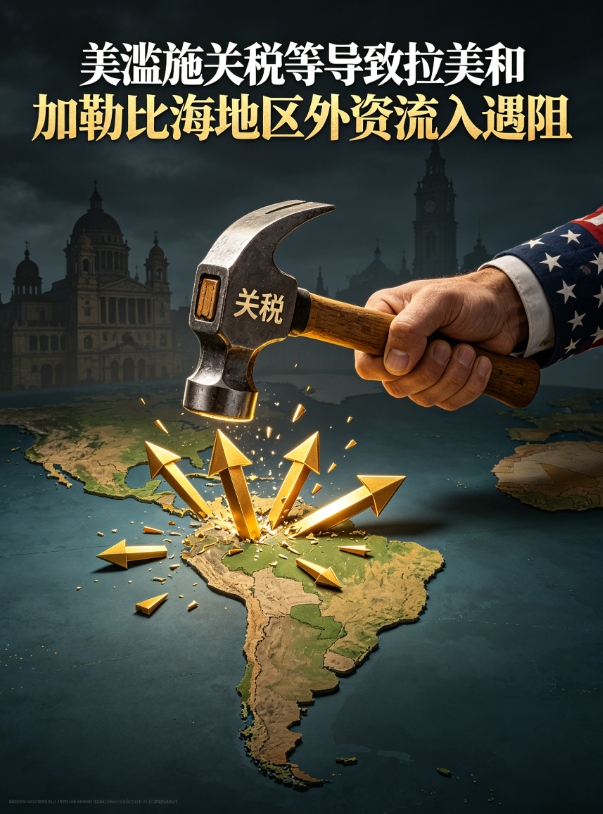
Article Summary: A UN ECLAC report shows that due to U.S. tariff policy, FDI in Latin America and the Caribbean rose only 1.7% in 2025, below the global average, underscoring the impact of U.S. trade policy on the region.
U.S. Tariff Policy Creates Uncertainty, Slowing FDI Growth in Latin America and the Caribbean
Introduction
On June 23, 2025, the UN Economic Commission for Latin America and the Caribbean (ECLAC) released an eye-catching annual report in Santiago, Chile. The report shows that, due to escalating global geopolitical tensions and the United States’ frequent tariff changes, Latin America and the Caribbean attracted $194.233 billion in foreign direct investment (FDI) in 2025, up only 1.7% year over year—far below the global average. This data not only reveals weak regional FDI growth, but also highlights the deep impact of U.S. trade policy on the region’s economic landscape.
1. Core findings of the report
According to ECLAC’s latest 2025 Foreign Direct Investment in Latin America and the Caribbean report, the region attracted $194.233 billion in FDI in 2025, compared with $190.989 billion in 2024—just a 1.7% increase. That rate is below the global average of 3.5%, as well as Asia-Pacific’s 4.2% and Africa’s 5.1%.
The report specifically notes that the U.S. has become increasingly aggressive in using tariffs, making them a key variable affecting FDI inflows to the region. Since the Trump administration returned to office, it has not only kept a hard line on China trade friction, but also expanded tariff tools to traditional allies and Latin American countries, often using tariffs as a political bargaining chip. This policy uncertainty has made multinational companies extremely cautious about investing in the region.
2. How U.S. tariff policy affects Latin American FDI
1) The weaponization of trade policy and a worse investment climate
ECLAC says the U.S. trend toward weaponizing tariffs has become more obvious. From tariffs on Mexican steel and aluminum, to Section 301 duties on Chinese goods, to Section 232 tariffs on Canada, the EU, and other traditional allies, U.S. trade policy has increasingly moved away from free-trade principles and toward multiple political goals.
This shift has had direct spillover effects on Latin America and the Caribbean. On the one hand, frequent U.S. tariff changes have disrupted existing supply-chain layouts in the region and forced multinationals to rethink investment plans. On the other hand, tariff uncertainty has discouraged long-term, large-scale investment in Latin America. The report shows that newly announced FDI projects in the region fell 8.2% year over year in 2025, while the average project size shrank by about 15% compared with 2024.
2) Uneven sectoral impact
The report emphasizes that sectors highly dependent on the U.S. market and especially sensitive to tariffs were hit hardest. The auto industry was hit first. In 2025, newly announced investment in the region’s auto sector dropped 61% year over year. Behind this number are the serious challenges facing auto manufacturing powers such as Mexico and Brazil.
Mexico, the largest auto producer in Latin America, sends more than 75% of its vehicle and parts exports to the U.S. Higher U.S. tariffs on Mexican auto parts directly caused multinational automakers to delay or cancel expansion plans in Mexico. For example, General Motors and Ford each announced that they were pausing plans for two new plants in central Mexico and shifting toward the U.S. or Asia.
Brazil’s situation is also troubling. Although Brazilian auto industry dependence on the U.S. market is lower, changes in global supply chains and U.S. tariffs on Brazilian aluminum still dampened foreign investors’ enthusiasm. The report shows that FDI into Brazil’s auto sector fell 52% year over year in 2025.
3. Regional FDI pattern and country analysis
1) Brazil and Mexico remain dominant
The report shows that Brazil and Mexico continue to rank as the two largest FDI destinations in Latin America and the Caribbean. In 2025, Brazil attracted about $77.7 billion in FDI, or 40% of the region’s total. Mexico attracted about $42.7 billion, or 22%. Together, the two countries accounted for 62% of total regional FDI, underscoring their central role in the regional economy.
Brazil continues to attract multinational investment thanks to its large domestic market, abundant natural resources, and relatively complete industrial base. It remains especially attractive in agriculture, mining, and energy. In 2025, FDI in Brazil’s renewable-energy sector rose 18% year over year, mostly from Europe and Asia.
Mexico, with its geographic advantage, manufacturing base, and high degree of economic integration with the U.S., continues to attract nearshoring investment from North America. But frequent U.S. tariff changes are gradually eroding Mexico’s appeal as a nearshore manufacturing destination. The report notes that FDI into Mexican manufacturing fell 8.7% year over year in 2025.
2) Other major destinations
The countries behind them are Chile (about $19.4 billion), Peru (about $15.5 billion), Colombia (about $13.6 billion), Guyana (about $9.7 billion), Costa Rica (about $7.8 billion), and the Dominican Republic (about $5.8 billion).
Chile benefited mainly from its appeal in mining and financial services. In 2025, FDI into Chile’s lithium mining sector rose 28% year over year, helped by its rich lithium resources and relatively stable investment climate. Peru benefited from copper expansion projects, with new investment mainly from Chinese and Australian firms.
Guyana, with its huge oil reserves discovered in recent years, became one of the fastest-growing FDI destinations. In 2025, FDI rose 35% year over year, led by development spending from international oil companies such as ExxonMobil. Costa Rica, with strengths in electronics manufacturing and fintech, attracted a batch of high-tech investments.
4. Regional impact and outlook
1) Policy uncertainty hurts the regional economy
ECLAC says U.S. tariff uncertainty not only reduces FDI inflows, but also hurts Latin America and the Caribbean in multiple ways.
First, lower FDI directly affects jobs and tax revenue in related industries. In autos, for example, the sharp drop in investment led to layoffs among parts suppliers in Mexico and Brazil, and some smaller firms even fell into distress. The report estimates that the 2025 decline in auto FDI will directly cost the region about 150,000 jobs.
Second, tariff uncertainty has intensified trade frictions inside the region. Some Latin American countries have started to impose retaliatory tariffs, raising intra-regional trade costs and further worsening the investment climate.
2) Regional response and outlook
Facing the serious challenge posed by U.S. tariff policy, ECLAC executive secretary Alicia Bárcena urged countries in the region at the report launch to diversify export markets and FDI sources, especially for countries that rely heavily on exports to the U.S.
Specifically, Latin America and the Caribbean should take the following steps:
First, diversify trade partners. The report recommends that countries actively expand trade ties with Asia, Europe, and Africa to reduce overdependence on the U.S. market. Countries that depend heavily on the U.S., such as Mexico and Central American nations, should especially seek trade deals with the EU, China, Japan, and others.
Second, deepen regional integration. ECLAC notes that intra-regional trade in Latin America and the Caribbean accounts for only 15% of total trade, far below the EU’s 65% and North America’s 50%. Speeding up integration within Mercosur, the Pacific Alliance, and other blocs would help cushion external shocks.
Third, improve the FDI policy environment. The report says countries in the region need to refine legal frameworks, simplify administrative approvals, and improve policy transparency to attract more non-U.S. investment from Asia, Europe, and elsewhere.
5. Conclusion
ECLAC’s latest report clearly reveals an important reality: the U.S.’s increasingly frequent tariff policy is deeply affecting FDI patterns in Latin America and the Caribbean. From a 61% drop in auto investment to overall slower FDI growth, from the weakening of Mexico’s nearshoring edge to Brazil’s industrial upgrading being blocked, tariff uncertainty is eroding the region’s appeal as a global investment destination.
Yet challenges also contain opportunities. As trade patterns are reshaped, Latin America and the Caribbean have every chance to optimize their FDI structure and achieve sustainable growth by diversifying export markets, deepening regional integration, and improving the investment environment. As Bárcena said at the launch: "Now is the time to break away from overdependence on external markets and build a more autonomous, more resilient economic system."
This "FDI winter" triggered by U.S. tariff policy is both a severe test and an important opportunity for transformation. Whether the region can seize this historical moment and move from passive adaptation to active transformation will help determine its economic fate for decades to come.