
Article Summary: Helens’ Chinese trademarks, including “Helen’s,” were ruled invalid on final appeal, sending the stock sharply lower and wiping out more than 90% of market value. Meanwhile, store contraction and same-store declines persist, leaving “the first bar for young people” under pressure.
Helens tavern Chinese trademark ruled invalid on final appeal, with Hong Kong stock falling and business pressure mounting
Have you been to Helen's? Helens recently lost its “Chinese name.” The Chinese trademarks “Helens,” “Helens Tavern,” and “Helens Yueda Dapai” were all ruled invalid by the court on final appeal.
Helens trademark dispute: final ruling invalidates the marks
Founded in 2009, Helens first opened in Beijing’s Wudaokou area. Founder Xu Bingzhong once said the company originally targeted foreigners and overseas students. It first used the English brand name “Helen's,” while the Chinese trademarks were not registered until 2018, which is seen as one source of later risk.
According to Jiemian News, the dispute mainly arose between Chengdu Helen Binfeng Hotel Co., Ltd. and Helens. The former registered two “Helen” trademarks in 2016 covering Class 43 restaurant and bar services, and on May 23, 2023 filed an invalidation request against the “Helens” mark, followed by requests on August 7, 2024 against “Helens Tavern” and “Helens Yueda Dapai,” claiming the marks were similar to earlier cited marks for similar services and were likely to cause confusion.
After a three-year tug-of-war, on the evening of June 25, Helens announced that the three Chinese trademarks were invalidated in the final ruling. The announcement said the dispute is currently assessed as having no material impact on the group’s overall business, daily operations, or financial condition, and the group can continue using uncontested trademarks in its day-to-day business.
Reporters found that its offline stores and online communications are still using Chinese expressions such as “Helens” for now. The impact has not yet clearly reached stores, but the capital market is more sensitive.
Capital market reaction: stock falls, market cap shrinks by over 90%
After the news was announced, the stock opened lower on June 26 and at one point fell more than 6%. By the close that day, Helens’ share price had dropped to HK$1.58. Helens’ market cap once reached HK$30 billion in the year it listed, but it is now only about HK$2 billion, a decline of more than 90%.
“Young people’s first tavern” is no longer young: expansion, transformation, and same-store decline
Helens’ earliest stores were located around university clusters, with foreign customers and students among the main consumer base. Later, founder Xu Bingzhong repositioned it as “a space for free offline socializing for young people,” while emphasizing extreme value for money: bottled beer was priced below RMB 10, and cocktails, though slightly more expensive, were still in the RMB 20 range.
The “young people + value” model was quickly replicated. Data show that by the end of 2021, Helens had 782 stores and listed in Hong Kong that year, becoming “China’s largest chain tavern.” The prospectus showed revenue of RMB 115 million, RMB 565 million, and RMB 818 million from 2018 to 2020; net profit was RMB 9.734 million, RMB 79.136 million, and RMB 70.072 million, respectively.
Its prospectus also showed that self-owned alcoholic beverages contributed more than 60% of Helens’ beverage revenue, with gross margins above 70%; meanwhile, by buying directly from factories and leveraging scale, it obtained relatively favorable third-party brand liquor purchase prices.
One advantage was scale. But expansion sharply increased store-opening costs, and with the impact of the pandemic and other factors, the company posted a net loss of RMB 230 million in 2021, which widened to RMB 1.601 billion the next year. After cumulative losses exceeded RMB 1.8 billion, Helens began shutting stores to survive. By the end of 2023 it had 479 taverns, down 288 from a year earlier and more than 40% below the peak of over 850.
It also launched a strategic shift from fully self-operated stores to franchising, introducing the “Hi Beer Partner” program. At launch, the minimum investment threshold was RMB 600,000, and in 2024 the threshold for the new store format dropped to about RMB 400,000, reflecting pressure to expand while improving operations.
Operational challenges amid industry divergence: same-store decline and city-tier mix
Its 2025 results showed full-year revenue of RMB 540 million, down 28.3% year over year; net profit attributable to shareholders was RMB 33.954 million, successfully returning to profit. The share of self-owned beverage revenue and gross margin both improved year over year, and store-level gross profit contribution rose to 73.77%, showing better overall operations than the prior year.
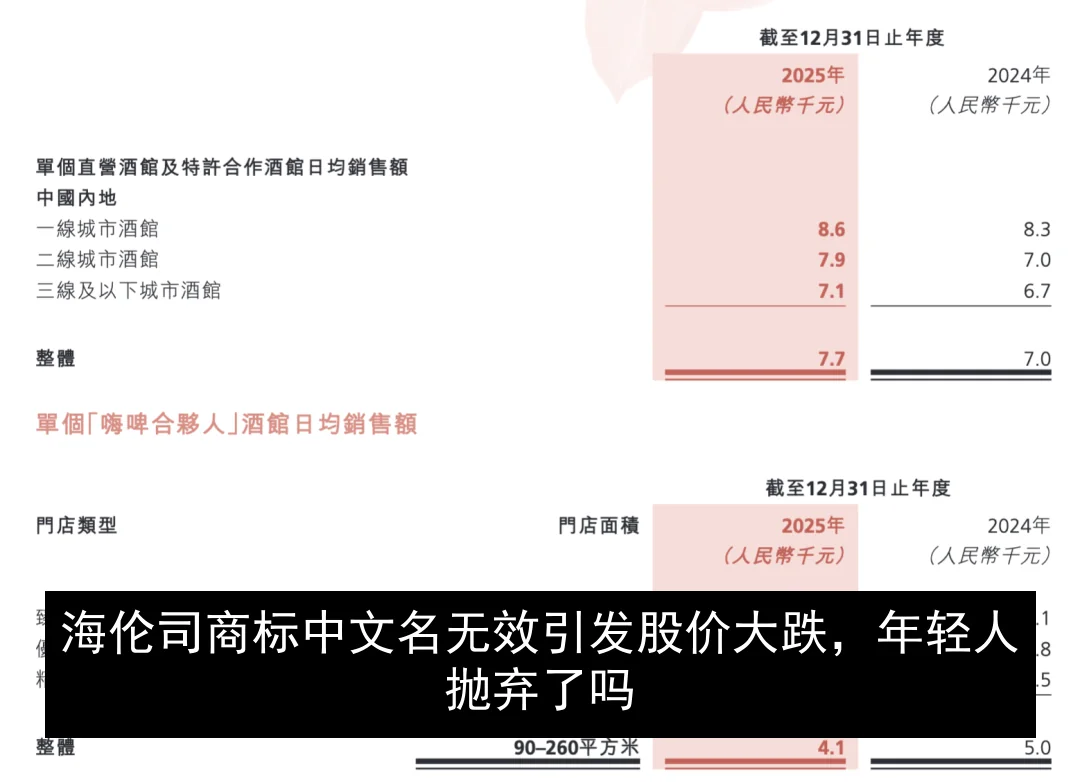
But the store-level reality remains harsh: in 2025, same-store average daily sales for directly operated and franchised/partner stores were RMB 8,500, down more than 18% year over year; average daily sales per partner store were only RMB 4,100, and all store types saw declines. In the restaurant sector, where daily sales per store can easily exceed RMB 10,000, the profit room for the main franchise format is under pressure.
In addition, nearly 70% of Helens’ stores are located in third-tier cities and below, which objectively pressures profitability.
On the other hand, young people now have more drinking and socializing options, and low-price appeal is weakening. Narrow Door Restaurant data show that 38,000 new bars opened in the past year, and consumer scenes have diversified from home bars and craft-beer pubs to live-house-style bars and various bistro formats.
Among them, the “food + drinks” bistro segment has risen strongly in recent years. Within this segment, the restaurant-bar operator HuanShi has grown rapidly, and its parent company, Jiwu Siwei, filed a prospectus with the Hong Kong Stock Exchange in January this year. HuanShi has more than 100 stores in China, and its 2024 revenue exceeded RMB 1 billion.
Unlike Helens, which won the market with low prices and scale, HuanShi takes a more ambience-driven and mid-to-high-price path, with per-capita spending above RMB 100. On social media, one of the impressions people mention is “pretty-food restaurant.” Its prospectus shows that average daily sales per store were RMB 29,880 in the first nine months of 2025; by offering brunch, afternoon tea, dinner, and late-night drinks, business hours were extended to more than 18 hours, increasing store utilization. In the first nine months of 2025, drinks and beverages contributed about 45% of revenue, of which 85% was alcoholic drinks; gross margin was steady at 68.7%, above the industry average.
At the same time, HuanShi also faces store-cost and reputation risks, as consumer complaints about taste and quality can affect the brand.
Food industry analyst Zhu Danpeng said that, like the coffee sector, the tavern industry has low, mid, and high pricing tiers, each with its own market. For taverns, brand effect, scale effect, fan effect, supply-chain completeness, and single-store operating ability are the more “hardcore” factors. Because each store is in a different location, strategies should be differentiated.
For Helens, how to run every single store well remains the biggest challenge.