
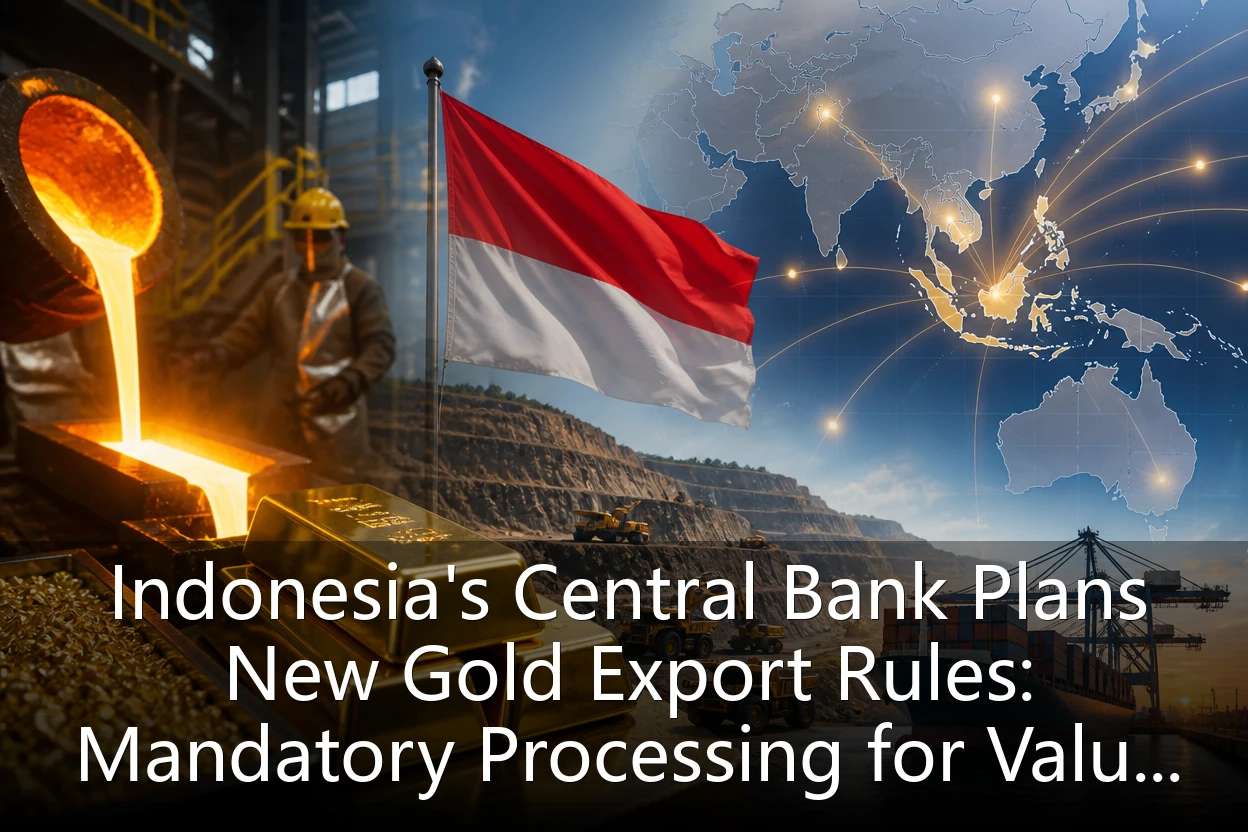
Article Summary: Indonesia plans to enforce new gold export controls in Q4 2026, mandating domestic smelting and processing of all gold ore prior to export to boost added value. The move aims to position Indonesia as a gold refining hub in the Asia-Pacific, significantly reshaping global gold supply chains and regional pricing mechanisms. This report delivers an in-depth analysis of the policy background, industry impact, and potential ripple effects across the Asia-Pacific gold market.
Indonesia's New Gold Export Policy Emerges: Targeting Domestic Processing Value Addition
Against the backdrop of Asia-Pacific central banks increasing gold holdings and accelerated global supply chain restructuring, Indonesia, Southeast Asia's largest economy, is planning a major policy adjustment for gold exports. According to sources close to Indonesia's Coordinating Ministry for Maritime and Investment Affairs and the central bank, the government is formulating a new regulation to enhance mineral added value, to be implemented before Q4 2026, requiring all gold ore mined in Indonesia to undergo domestic smelting and refining before export. This policy direction marks a substantial step forward in Indonesia's resource nationalism regarding critical minerals, with implications that will not only reshape the physical gold supply chain in the Asia-Pacific but also potentially exert a profound influence on the regional premium structure of global gold prices.
Indonesia has previously successfully implemented a similar 'downstreaming' mandatory processing policy in the nickel sector, attracting numerous global battery and stainless steel industry chain giants to establish local facilities. Now, Indonesia is attempting to replicate this successful experience in precious metals such as gold and copper. Indonesia hosts one of the world's largest gold mines, the Grasberg mine, operated by a joint venture between state-owned mining company Antam and international giant Freeport-McMoRan, with substantial annual output. Currently, some gold concentrate from this mine is still exported to smelters in Japan, China, and other countries for final purification. Once the new regulation takes effect, this portion of capacity will be forced to return to Indonesia.
Policy Background: The 'Downstreaming' Logic from Nickel to Gold
Indonesian President Joko Widodo and his successors have consistently made 'resource downstreaming' a core national economic development strategy. By banning raw ore exports and mandating domestic smelter construction, Indonesia has transformed from a mere nickel ore exporter into a global nickel processing hub. Although this policy initially sparked strong opposition from trade partners like the EU and led to WTO disputes, Indonesia ultimately succeeded in driving industrial chain relocation through its strong resource bargaining power and market appeal. Now, gold has been added to the next phase of the 'downstreaming' list.
For the gold industry, Indonesia's policy rationale is threefold: first, by mandating domestic processing, gold ore will be transformed into higher-purity gold bars or ingots before export, thereby capturing the high added value of the processing stage; second, to attract international capital and technology into Indonesia's gold smelting and chemical sectors, driving employment and infrastructure development; third, to establish a national-level gold inventory and reserve mechanism, enhancing monetary and financial resilience in the face of global financial turmoil. This aligns with the trends of 'de-dollarization' and central bank physical gold accumulation previously observed by Asia-Pacific gold market strategy research.
Asia-Pacific Gold Supply Chain Faces Restructuring: Regional Premiums May Emerge
If implemented, the new regulation will have an immediate impact on the gold supply landscape in the Asia-Pacific region. Currently, Australia, China, and Indonesia are the top three gold producers in the region. However, unlike Australia and China, which have mature domestic smelting and consumption systems, Indonesia's gold refining capacity is relatively underdeveloped. In the short term, constrained by bottlenecks in domestic smelting capacity, the new regulation may lead to phased disruptions or delays in Indonesian gold exports, thereby tightening spot market supply in the Asia-Pacific.
Market analysts point out that such supply-side disruptions are likely to push up the spot gold premium over London gold during Asian trading hours. Particularly in major gold trading hubs like Singapore and Hong Kong, any disruption in gold bar supply from Indonesia will prompt downstream jewelry manufacturers and investors to seek spot gold from other sources, leading to sharp short-term volatility. Long-term Asia-Pacific gold price trend analysis will need to incorporate the 'Indonesia premium' as a new variable into models. For gold smelting and processing enterprises in the Asia-Pacific, this presents both challenges and opportunities; companies with advanced smelting technology and environmental treatment capabilities may gain new tolling orders or technology export opportunities.
Investment Strategy and Market Dynamics: Focus on Refining Capacity and Policy Details
For investors, the current phase requires close attention to the specific implementation rules announced by the Indonesian government, including the transition period length, exemption clauses for existing export contracts, and whether free export is allowed after meeting certain processing depth requirements. These details will directly determine the magnitude of market volatility. From a gold investment strategy perspective, in the short term, consider establishing long positions during Asia-Pacific trading sessions to hedge against upside price risks arising from supply uncertainty. In the medium term, it is necessary to assess the construction progress of domestic refineries in Indonesia; once the capacity bottleneck is overcome, the eastward shift of global gold refining capacity will reshape long-term pricing power.
This supply-side reform driven by resource nationalism is intertwined with multiple factors, including global central bank gold accumulation, intensifying geopolitical risks, and expectations of Fed rate cuts. Indonesia's move undoubtedly adds new variables to the already turbulent Asia-Pacific gold market, and its policy spillover effects warrant heightened vigilance and in-depth analysis from every precious metals market participant.