
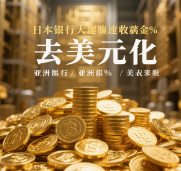
Article Summary: Bank of Japan announced raising gold reserve ratio from 2% to 5%, joining Asia-Pacific central banks in gold accumulation. The move is seen as a key signal to cope with USD volatility and diversify FX reserves. Analysts say regional gold demand shifts from consumption to strategic reserves, supporting gold prices long-term.
On July 25, 2026, the Bank of Japan unexpectedly announced a major policy adjustment: plans to gradually increase the share of gold in foreign exchange reserves from the current 2% to 5% within three years. This move has drawn global financial market attention, especially against the backdrop of central banks worldwide competing to increase gold holdings, marking a reshaping of the gold market landscape in the Asia-Pacific region.
I. Deep Logic Behind BOJ's Gold Turn
In its statement, the Bank of Japan stated that this gold increase is based on the long-term strategic consideration of "optimizing reserve asset structure and reducing dependence on a single currency." As of the end of June 2026, Japan's foreign exchange reserves stood at approximately $1.3 trillion; raising gold's share to 5% would require adding about 3,900 tons of gold (valued at about $75 billion at the current international gold price of approximately $1,960 per ounce). Although the Bank of Japan did not specify the exact pace of purchases, the market predicts that its average annual gold purchases will exceed 1,000 tons over the next three years, making it one of the world's largest sovereign gold buyers.
Behind this decision lies a microcosm of the collective "de-dollarization" by Asia-Pacific central banks. Japan has long held the world's largest amount of U.S. Treasury bonds, but in recent years, U.S. dollar credit has been shaken by U.S. debt issues. In 2025, the U.S. federal government debt exceeded $38 trillion, with Fitch and Moody's successively downgrading the U.S. sovereign credit rating, prompting Asian countries including Japan to reassess their foreign exchange reserve composition. According to Japan's Ministry of Finance data, Japan reduced its U.S. Treasury holdings by about $50 billion in 2025, while increasing holdings of gold, yen, and RMB assets.
II. Wave of Asia-Pacific Central Bank Gold Purchases: Paradigm Shift from Consumption to Reserves
The Bank of Japan's move is not an isolated case. Since 2022, central banks worldwide have maintained annual net gold purchases exceeding 1,000 tons for four consecutive years, with the Asia-Pacific region contributing the major increment. In 2025, the People's Bank of China announced that its gold reserves had increased to 2,280 tons, accounting for 4.5% of foreign reserves; the Reserve Bank of India added 120 tons during the same period, and ASEAN countries such as Vietnam, the Philippines, and Indonesia also continued buying.
In its latest report released in July 2026, the World Gold Council (WGC) pointed out that the Asia-Pacific region is undergoing a transition from a "gold consumption center" to a "gold reserve center." Over the past decade, private gold consumption (jewelry, bars, coins) in the region grew at an average annual rate of 3%, while central bank gold purchases increased at a rate of 12%. This structural change means that the pricing power of gold is shifting from exchanges in London, New York, and consumer markets like Dubai to the decision-making levels of Asia-Pacific central banks.
"The Bank of Japan's action may trigger follow-up from other Asian countries, especially South Korea, Thailand, and Australia," said Singapore gold market analyst Lin Weiming in an interview. "Currently, the international gold price is fluctuating around $1,960, and systematic buying by central banks will provide a solid floor for gold prices." According to CME data, as of July 24, net long positions in gold futures increased 8% month-on-month to 280,000 lots, with Asia-Pacific institutional funds accounting for 35%.
III. Policy Impact: Tariff Adjustments and Regional Cooperation
To meet central bank reserve accumulation needs, Asia-Pacific countries have adjusted their gold trade policies. The Indian government reduced the gold import tariff from 12.5% to 9% in its 2026 federal budget to curb smuggling and encourage legal imports; Hong Kong announced the establishment of an "Asia-Pacific Gold Cross-Border Settlement Pilot Zone," allowing central banks to directly settle gold transactions in Hong Kong dollars and offshore RMB.
More notably, in June 2026, the central banks of seven countries including Japan, China, and Singapore announced the establishment of an "Asia-Pacific Gold Reserve Cooperation Mechanism," aimed at sharing gold reserve management experience and establishing a regional gold pricing benchmark. The mechanism plans to launch an "Asian Gold Index (AGI)" based on Asian trading hours in 2027, to weaken the impact of London gold on the Asia-Pacific region.
IV. Gold Price and Market Strategy Outlook
Following the announcement of Japan's reserve increase, spot gold briefly surged to $1,978 per ounce during Asian trading hours, before retreating to around $1,965. Technically, gold has broken through the mid-term resistance level of $1,950, with the RSI at 65 in a neutral-to-strong zone. Goldman Sachs in its latest research report raised its year-end 2026 gold price target to $2,200 per ounce, with the core logic being continued gold buying by Asia-Pacific central banks and expectations of a weaker U.S. dollar.
For investors, the Asia-Pacific gold market strategy suggests focusing on the following areas:
- Gold Mining Stocks: Asia-Pacific gold miners listed in Australia and Canada, such as Newcrest and Barrick Gold (Asia-Pacific operations), benefit from rising gold prices and production expansion;
- Gold ETFs: Gold ETF holdings in the Asia-Pacific region have increased for 12 consecutive months, with SPDR Gold Trust (Asia-Pacific division), Huaan Gold ETF, and others reaching new highs in scale;
- Gold Coins and Bars: The Bank of Japan's reserve increase may drive safe-haven sentiment among the public, with popular products such as Panda Gold Coins in China and the Australian Kangaroo Nugget selling well in Japan and China;
- Gold Futures Spread: The spread between London gold and Shanghai gold has narrowed to within $0.5 per ounce, indicating increased Asia-Pacific pricing power, presenting cross-market arbitrage opportunities.
V. Risks and Controversies
Despite frequent positive news, the gold market also faces concerns. Large-scale gold purchases by the Bank of Japan could push up domestic inflation (gold priced in yen), and if the Federal Reserve unexpectedly raises interest rates (currently maintaining 4.75%-5.0%), a stronger dollar would suppress gold prices. Additionally, holdings in the world's largest gold ETF, SPDR Gold Trust, saw a slight decrease in the second quarter of 2026, indicating some speculative profit-taking at high levels.
"Gold prices have already priced in too many central bank purchase expectations. If the execution falls short, there is a risk of a correction," warned Julius Huang, UBS commodities strategist. However, he added that the structural trend of Asia-Pacific central bank reserve accumulation remains, and any pullback is an opportunity for long-term positioning.
Conclusion
The Bank of Japan's gold reserve increase plan is a milestone in the restructuring of the Asia-Pacific monetary system. When the gold market is no longer dominated solely by algorithmic trading in New York and London, but closely linked to the decisions of central banks in Tokyo, Beijing, and Singapore, the value of "Asia-Pacific Gold Market Strategy" becomes evident. Over the next three years, the global gold market will witness a "quiet revolution" led by sovereign central banks, and investors need to seize this historic opportunity.