
Article Summary: On Aug 7, the People's Bank of China reported gold reserves at 76.08 million ounces at end-July, up 640,000 ounces (about 20 tons) month-on-month, marking the 21st consecutive monthly increase since resuming purchases in Nov 2024. Spot gold returned above $4,300/oz the same day. WGC data showed Q2 global central bank buying of 289 tons, up over 60% YoY; 45% of surveyed central banks plan to add over the next year. This article analyzes the strategic logic and global implications of China's persi
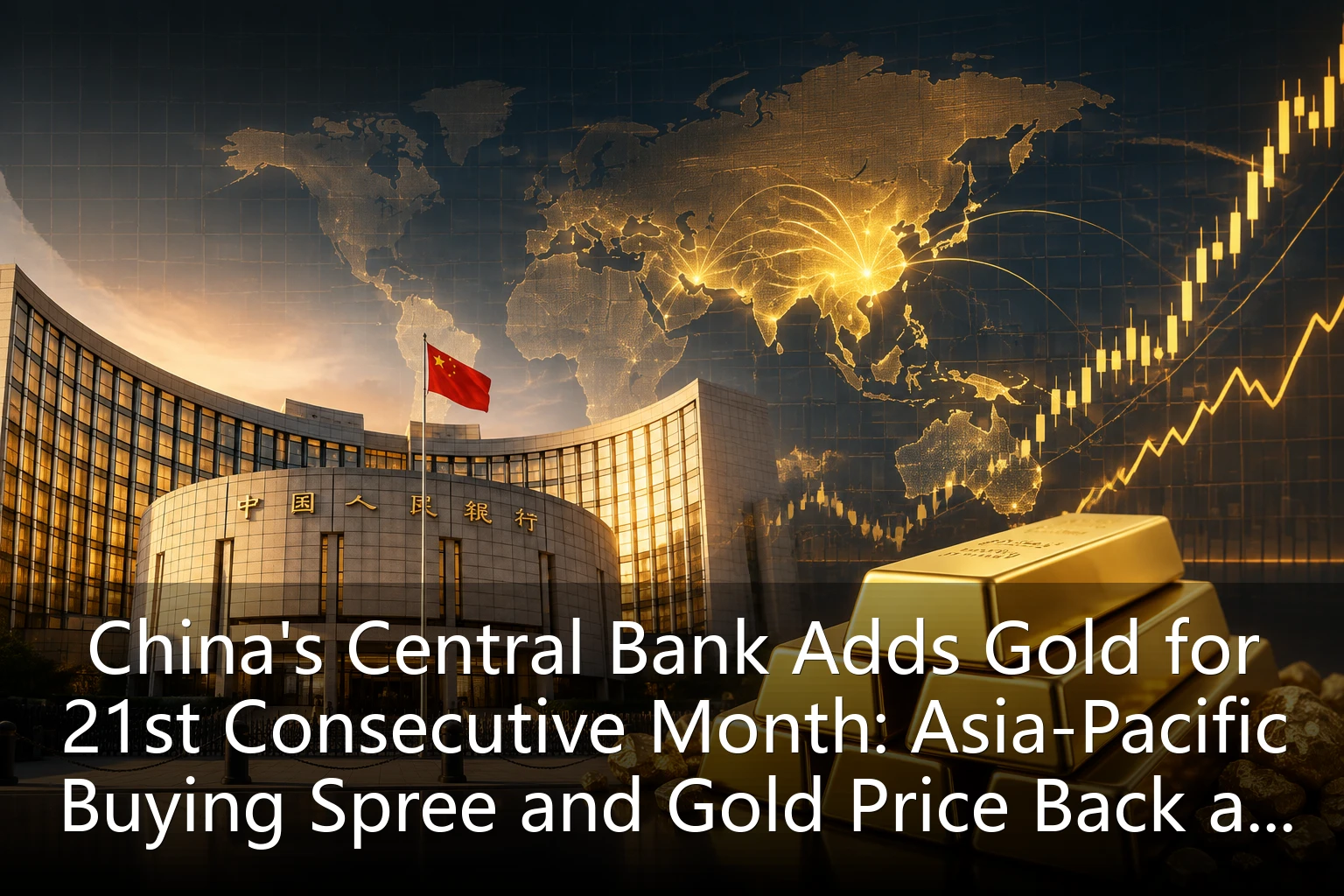
On August 7, the latest official reserve asset data released by the People's Bank of China showed that gold reserves rose to 76.08 million ounces by end-July, up 640,000 ounces (about 20 tons) from 75.44 million ounces at end-June, with the pace of purchases expanding from June's 480,000 ounces. This marks the 21st consecutive month of gold accumulation by the PBoC since it resumed buying in November 2024. On the same day, spot gold strengthened sharply during Asian trading hours, breaking back above the $4,300 per ounce level after nearly two months, with intraday gains exceeding 1.4%. The simultaneous resonance of central bank buying and the gold price rebound has once again made the Asia-Pacific gold market the focus of global investors.
21 Months of Consecutive Accumulation: Volatile Prices Do Not Change Allocation Logic
Since the PBoC resumed gold purchases in November 2024, the current buying cycle has lasted 21 months—a continuity rarely seen in central bank behavior over the past decade. Notably, this accumulation period coincided with extreme gold price swings: spot gold hit an all-time high of $5,595.47 per ounce on January 29, then fell sharply amid U.S.-Iran tensions, shifting Fed policy expectations, and strong inflows into the U.S. tech/AI equity sector, dropping to $3,959.33 per ounce on June 24—a maximum drawdown of over 26%. However, the sharp price swings did not disrupt the PBoC's steady pace of accumulation.
Ray Jia, Head of Research for Asia Pacific (excluding India) at the World Gold Council, noted that while some central banks may tactically adjust the timing of purchases based on price in the short term, surveys show that hedging geopolitical risks and pursuing reserve diversification remain the main objectives of central bank gold buying, and "price is not their primary consideration." This view aligns closely with the logic of reserve rebalancing amid the global de-dollarization wave—gold, as the ultimate asset free of sovereign credit risk, is being reassessed for its strategic value in turbulent environments.
Global Central Bank Buying Rebounds: Q2 at 289 Tons, Up More Than 60% YoY
The PBoC is not alone. According to the World Gold Council, global central bank gold purchases rebounded strongly to 289 tons in Q2 2026, up more than 60% year-on-year and above the historical average. In May 2026, global official gold reserves rose by a net 41 tons. Poland's central bank has bought 64 tons so far this year, lifting its reserves to 614 tons and gradually approaching its target of 700 tons. Central banks in Kazakhstan, Uzbekistan and other Central Asian countries have also maintained steady buying, making the Asia-Pacific region the undoubted "main engine" of this buying wave.
The WGC's 2026 Global Central Bank Gold Reserve Survey, released on June 16, showed that 45% of surveyed reserve managers expect to increase gold holdings over the next 12 months, up 2 percentage points from the previous year and the highest in the survey's history, while only 1% plan to reduce. The report also noted that gold has recently overtaken U.S. Treasuries to become the world's largest reserve asset, highlighting a major shift in official institutions' reserve allocation philosophy. Strategic demand from central banks has not reversed amid the gold price correction; instead, it has built solid bottom support during the pullback.
Gold Price Back at $4,300: Three Drivers Behind the Rebound
On August 7, London spot gold strengthened first during Asian hours, touching above $4,300 intraday with gains of more than 1.5%—the first time the price has reached this level since June 18. Based on multiple sources, this rebound is driven by three forces:
- Geopolitical risk easing expectations: Signs of de-escalation in the U.S.-Iran situation have allowed extreme pricing driven by safe-haven sentiment to normalize, prompting bargain-hunting in previously oversold gold;
- Shift in monetary policy expectations: Market expectations about the Fed's rate path have softened, and reduced rate-hike expectations have lowered the opportunity cost of holding gold, with the U.S. dollar index weakening in July providing further support;
- Continued central bank buying: Persistent accumulation by Asia-Pacific central banks led by China has established a clear bottom range for gold prices and strengthened bullish confidence.
Qu Rui, Senior Deputy Director of the Research and Development Department at Golden Credit Rating, believes the current move is still a phased rebound driven by eased U.S.-Iran tensions and cooling rate-hike expectations. There is room for further upside in the short term, but the subsequent trend will depend heavily on geopolitical developments, fundamental data, and policy signals. In other words, whether gold can move from a "rebound" to a "reversal" still requires observing the Fed's policy path and further geopolitical evolution. Notably, China's foreign exchange reserves stood at $3.4188 trillion at end-July, up $2.5 billion month-on-month. The official statement said that a weaker dollar and changes in global asset prices jointly supported the modest rise, while the resilience and vitality of the Chinese economy also underpinned the stability of foreign reserves.
The Rise of Asian Pricing Power: From Follower to Price Setter
A structural phenomenon of great significance in this round is that gold buying during Asian trading hours has been notably stronger than during U.S. and European sessions. The WGC pointed out that although international gold prices have declined overall since 2026, when looking only at Asian trading hours, prices have risen on average—the pullback occurred mainly during U.S. and European sessions, while Asian sessions have shown persistent buying support. Asian capital and central bank buying, led by China, are reshaping the global gold pricing landscape.
Juan Carlos Artigas, Head of Research and CEO of the Americas region at the World Gold Council, said the global gold market is moving away from an era of single Western dominance toward a more globalized, diversified multipolar pricing system. More than 50% to 60% of physical gold demand is rooted in Asia, so establishing an efficient and convenient trading and clearing network in Asia will not only better reflect supply-demand fundamentals but also give Asian markets a stronger voice in short-term price discovery.
Competition at the infrastructure level is also accelerating: Hong Kong's gold central clearing and settlement system began trial operations on July 7, achieving the first phase of "physical connectivity" with the Shanghai Gold Exchange. Hong Kong has also set a target of exceeding 2,000 tons of gold storage within three years. The Monetary Authority of Singapore plans to launch central bank vault services in October, offering secure storage options for foreign central banks and sovereign entities. The improvement of the full-chain infrastructure—trading, clearing, storage, and refining—is providing solid hardware support for Asia's gold pricing power.
Outlook and Strategy: Gold's Role as a Stabilizer Comes to the Fore Again
Overall, the central bank buying wave provides long-term structural support for gold prices. Historical experience shows that when gold prices fall significantly, physical demand from jewelry consumption, electronics manufacturing, and central bank strategic reserves quickly steps in, limiting downside. For Asia-Pacific investors, in an environment where geopolitics can reshape asset pricing at any time and monetary policy paths remain highly uncertain, gold's allocation value as a portfolio "stabilizer" is again highlighted.
Looking ahead, three key variables must be monitored. First, the final direction of the Fed's rate path—if rate hikes prove more aggressive than expected, gold will face new headwinds; conversely, if the Fed pauses or turns to cuts earlier, gold will get strong upside support. Second, the pace of geopolitical risk evolution—recurring tensions in the Middle East could still trigger sharp, pulse-like gold price swings. Third, whether Asia-Pacific physical demand and central bank buying can sustain their current strength. According to the WGC survey, 89% of central bank governors expect global gold reserves to continue rising over the next 12 months, a medium-to-long-term trend that is unlikely to reverse in the short term. For ordinary investors, rather than chasing rises and selling falls amid short-term volatility, it is more prudent to incorporate gold into a medium- to long-term asset allocation framework to cope with an increasingly uncertain macro environment.