Article Summary: This week the three major Hong Kong indices remained weak, with the Hang Seng and Tech indices hitting new phase lows and structural divergence intensifying: new listings surged against the trend, locked-up shares were hit hard, and funds flowed into defensive sectors such as pork and healthcare. The article analyzes the market drivers and sector-rotation logic in depth.
Sure, following your requirements, I will create a professional, in-depth, and well-structured analysis based on the provided reference material.
Hong Kong Weekly Review: Indexes Under Pressure, Structural Divergence Deepens, New Listings and Defensive Sectors Break Out Against the Trend
Keywords: Hong Kong stock market, Hang Seng Index, Hang Seng Tech Index, IPO performance, lockup pressure, defensive sectors
[Introduction]
This week (June 19 to June 25), the three major Hong Kong indices continued their weak trend, showing a range-bound bottoming pattern. Against a backdrop of diverging global risk assets, Hong Kong’s tech sector—lacking heavy AI hardware exposure—came under clear pressure, and both the Hang Seng Index and the Hang Seng Tech Index hit new phase lows. At the same time, internal market divergence intensified: on one side, newly listed stocks staged eye-catching “wealth creation miracles” thanks to their scarcity and small float; on the other, heavy lockup expiries and market rumors triggered sharp drops in some names. Amid the index weakness, risk-off sentiment rose, and traditional defensive sectors such as pork and healthcare attracted funds and became a bright spot. This article analyzes the week’s key market drivers, sector-rotation logic, and the deeper reasons behind major stock moves.
[Main Text]
1. Index Breakdown: Supply and Structural Problems Emerge
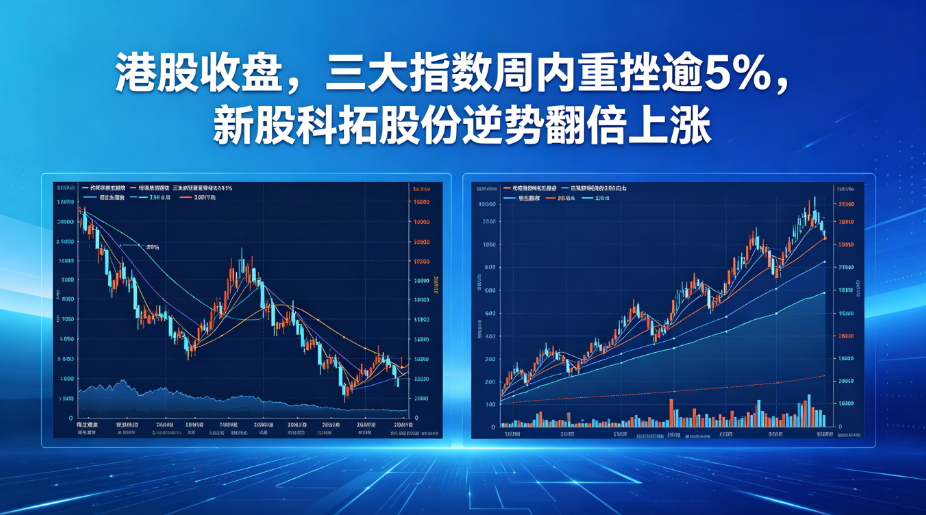
This week, the Hang Seng Index fell 5.24% to 22,671.86, a new low since last June; the Hang Seng Tech Index fell even more, down 7.57% to 4,255.59, the lowest since January last year; the Hang Seng China Enterprises Index also dropped 6.46%. The continued correction was not random. It reflects two core pressures:
First, a structural mismatch in global industry rotation. As CICC points out, global risk assets are extremely polarized. Markets like the KOSPI and China’s STAR 50, with very high weights in AI hardware—such as HBM chips and compute chips—have fully benefited from the AI profit-realization cycle and therefore performed strongly. In contrast, the Hang Seng Index and Hang Seng Tech Index are more weighted toward internet platforms, consumer, and financial stocks, with very little AI hardware exposure, so they missed the momentum of this AI-led wave. This makes Hong Kong stocks look out of sync with the broader global tech rally and reduces their attractiveness to capital.
Second, liquidity pressure from a massive lockup expiry wave. The market faces a major supply-side challenge. Data show that in Q3 2026, Hong Kong is expected to see more than HK$850 billion in share unlocks, concentrated in metals, software services, and healthcare. With sentiment already fragile, expectations of large upcoming unlocks are prompting capital to leave early, increasing short-term liquidity pressure and downside risk. The plunge in PharmaBlock Sciences-N (药捷安康-B) this week is an extreme preview of this risk.
2. Fire and Ice: IPO Frenzy and Stock Collapses
Behind the weak index, individual stocks diverged to an extreme degree, creating a true “fire and ice” market.
(1) IPO market: scarcity and small-float effect ignite rallies
The week’s top gainers were almost entirely recent listings, and their huge gains became the market’s most eye-catching feature.
- Chinapcb: as the world’s largest direct-imaging equipment supplier for PCBs, its rare leadership status in semiconductors and PCB equipment attracted capital immediately, and the stock jumped 103.77% for the week.
- Keto Group: with its unique “smart parking first stock” concept and very fast listing pace, it successfully reignited speculation, rising 203.92% for the week.
- Haqing Zhiyuan: riding this week’s “Hong Kong AI sector” theme and backed by thousands of times oversubscription in public offer, it surged on debut and gained 158.19% for the week.
These performances show that when the market lacks a clear main theme, funds concentrate on “scarce names” with unique sector stories and small floats, creating massive short-term money-making effects. But the speculative risks are equally huge.
(2) Stock-specific risks: unlock “nukes” and rumor “black swans”
In sharp contrast to the IPO frenzy, some stocks were hit hard for very different reasons, and the lessons are stark.
- PharmaBlock Sciences-N (down 67.84% this week): This stock perfectly illustrates the market rule that success and failure can come from the same source. It was added to the Stock Connect list because of its tiny float, then surged 50-fold in eight days and became a “monster stock legend.” But on Monday (June 22), the second lockup period expired exactly one year after listing, and the unlocked shares represented more than 90% of total share capital. It was like opening a floodgate: the pressure from huge low-cost supply instantly crushed the share price, causing a drop of nearly 70%. This is a vivid lesson in lockup risk.
- Topo Sports (down 29.84% this week): Market rumors sparked its plunge. Rumors said its largest partner Nike planned to end all online first-tier distribution rights starting in 2027. Although the company quickly issued a clarification, panic selling was hard to stop. This shows how fragile sentiment is: any unverified negative news can be amplified and cause a stampede.
- China Gold International (down 20.97% this week): Its decline was closely tied to macro commodity moves. With international gold and copper prices pulling back from highs, profit-taking spread to gold and metals as a whole, a typical cyclical and sentiment-driven selloff.
3. Capital Rotates into Defense, Sector Rotation Returns
As risk appetite fell sharply, funds began moving into defensive sectors.
(1) Pork stocks attract capital against the trend
This week, pork stocks led by Muyuan Foods (up about 4%) performed well. The key driver was a company-level positive: several directors and senior executives announced plans to increase holdings by no less than RMB 400 million and no more than RMB 500 million. This real-money commitment sent a strong bottom signal, boosted investor confidence, and helped Wen’s Food, Dekon Food and Agriculture, and others stabilize and rise.
(2) Healthcare gets support from both policy and capital
The healthcare sector also showed strong resilience. Tigermed and Joinn Laboratories were among the leaders. Two core drivers stood behind this:
- Policy support: The annual report from China’s National Medical Products Administration showed that in 2025, the number of new drug clinical trials rose 18% year over year, and the total exceeded 5,000 for the first time, setting a record high. This signals that innovation remains strong and fundamentals are solid.
- Industrial capital buying low: Since April, A-share and H-share healthcare sectors have seen a wave of share purchases and buybacks, with dozens of companies announcing such actions and some pharma firms accumulating more than 40 buyback announcements. The market reads this as industrial capital recognizing the sector’s attractive valuations and providing strong value support.
[Conclusion]
Looking at Hong Kong stocks this week, it is clear that index weakness does not mean a lack of opportunities; rather, it signals a deep change in how the market works. The broad rally driven by valuation expansion in the past has ended. Going forward, the market will pay more attention to fundamentals, scarcity, and risk-reward balance at the individual-stock level.
In the months ahead, investors should focus on three points: first, macro liquidity and industry trends, especially the spillover from global themes like AI hardware into Hong Kong related sectors; second, on the micro side, watch for the impact of large unlock windows approaching; third, during this range-bound bottoming phase, consider policy-supported, fundamentally sound, and actively bought defensive sectors such as healthcare and consumer staples (like pork). The market’s “alchemy” is testing every investor’s insight and patience. Only by dropping impatience and focusing on value can one stay ahead in a structurally driven market.