
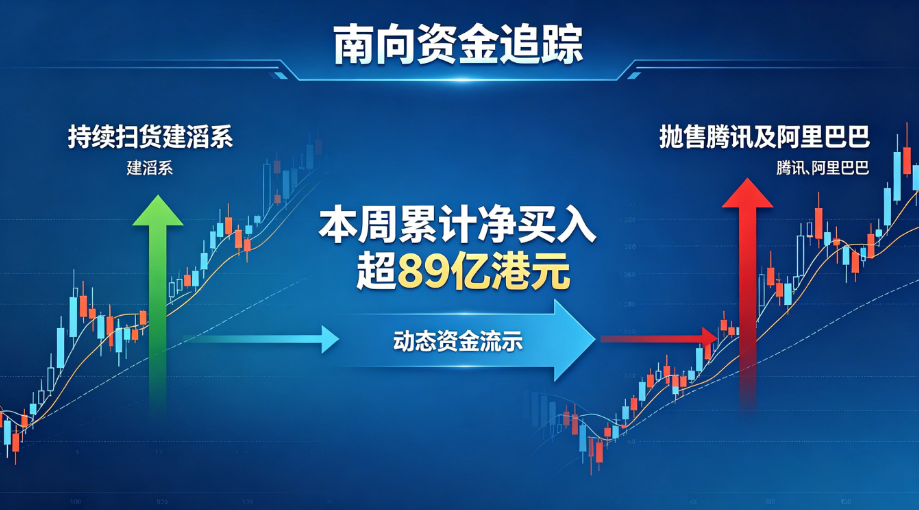
Article Summary: In the third week of March 2025, southbound capital posted a net buy of HK$8.924 billion, but Hong Kong stocks showed sharp structural divergence. Capital flows were pulse-like: about HK$26 billion was bought on Tuesday and Wednesday, then sold on Thursday and Friday. This article examines the dialectical relationship between southbound flows and Hong Kong market moves, discusses bottom-fishing traps and left-side positioning, and explains valuation re-rating and cycle turning points in core Hon
Southbound Capital Weekly Report: Structural Divergence and Sector Rotation in Hong Kong Stocks Amid Long-Short Battles
Introduction
In the third week of March 2025, the Hong Kong market once again staged a capital battle. Southbound capital recorded a cumulative net buy of HK$8.924 billion this week, a clear improvement from last week’s net sell of HK$4.441 billion. But beneath the surface, structural divergence was extremely sharp: on Tuesday and Wednesday, as the Hang Seng Index stabilized, southbound funds bought roughly HK$26 billion in total; on Thursday and Friday, after the index fell to new lows, flows turned out again. This paradox of “buying the dip as prices fall, then seeing prices fall after buying” reflects a deeper disagreement among institutional investors about valuation re-rating in core Hong Kong assets and about industry cycle turning points.
Starting from the macro features of capital flows, this article digs into the trading logic behind major stocks and, combined with industry fundamentals and market sentiment, explains the current structural opportunities and risks in the Hong Kong market.
1. The Dialectic Between Southbound Flows and Hong Kong Market Moves: Bottom-Fishing Trap or Left-Side Positioning?
This week’s southbound capital showed a classic “pulse-like” inflow pattern. On Tuesday and Wednesday, after a continuous decline, the Hang Seng Index rebounded technically, and southbound net buys reached HK$13 billion each day—more than 15% of daily turnover. But when the index broke the previous low on Thursday, funds quickly switched to a net outflow of HK$2.5 billion, and the selling continued on Friday. This “adding on rebounds, cutting on drops” pattern is more like a quant or event-driven strategy than traditional value investing’s contrarian logic.
On a weekly basis, the net buy of HK$8.9 billion looks positive, but excluding the concentrated buying on Tuesday and Wednesday, the other trading days were net outflows. This exposes the fragility of current southbound capital: it lacks the conviction for sustained buying and is more like short-term tactical “dip buying.” The deeper reason is that Hong Kong stocks face multiple headwinds: repeated Fed rate-cut expectations pressuring liquidity, a slower-than-expected recovery in mainland economic data, and rising geopolitical risk premiums. In this macro setting, southbound capital prefers quick in-and-out trades rather than long-term allocation.
It is worth noting that this week’s southbound net buy as a share of Hang Seng turnover was well above historical averages, showing that mainland funds are becoming a key marginal pricing force in Hong Kong stocks. But this force has not yet formed a consensus, and long-short disagreement remains huge.
2. Key Buy Names: A Dual Logic of Cycle Reversal and Domestic Substitution
2.1 Kingboard Holdings and Kingboard Laminates: Confirmation of the Copper-Clad Laminate Cycle Bottom
This week, southbound capital heavily bought Kingboard Holdings (00148.HK) for HK$13.766 billion and Kingboard Laminates (01888.HK) for HK$13.097 billion, ranking first and second among buy names. The two stocks together absorbed more than HK$26.8 billion—over 300% of the week’s total net buy, meaning other names were net sold overall. This extreme concentration reflects a strong consensus that the copper-clad laminate industry is at a cycle turning point.
Kingboard Holdings is the world’s largest copper-clad laminate producer, and Kingboard Laminates is its core subsidiary. Since the second half of 2024, demand from AI servers, new energy vehicles, and 5G base stations has recovered, and the industry’s two-year destocking cycle is finally nearing its end. In Q1 2025, major manufacturers began raising prices, and Kingboard was the first to announce a 5%-10% price increase. This week’s heavy accumulation is essentially a bet on the early stage of cycle recovery.
Technically, Kingboard Laminates rose 7.29% this week, with 81.17 million shares added in the first five trading days, showing accelerated inflows. Kingboard Holdings fell 0.16%, yet funds still added 61.12 million shares, indicating even stronger expectations for valuation recovery. The price divergence may stem from concerns over the group’s other businesses, such as property and chemicals, but southbound capital chose to take a larger position, showing strong confidence in a left-side entry.
2.2 SMIC and Hua Hong Semiconductor: Domestic Chip Substitution Enters Earnings Realization
SMIC (00981.HK) rose 4.58% this week, with southbound net buys of HK$8.696 billion and 68.74 million shares added in the first five days; Hua Hong Semiconductor (01347.HK) rose 12.73%, with net buys of HK$2.504 billion and 12.47 million shares added. These two chip stocks became the week’s top-performing large southbound holdings, marking a shift in semiconductors from “theme speculation” to “earnings-driven.”
2025 is a key year for domestic substitution in China’s semiconductor equipment sector, with localization rates expected to exceed 50%. As the country’s largest foundry, SMIC has lifted utilization from 70% in 2024 to above 80%, and advanced-node (N+2) yields continue to improve, making profitability in the second half of 2025 possible. Hua Hong Semiconductor is benefiting from a recovery in demand for power semiconductors, MCUs, and other specialty processes; its Wuxi 12-inch line is ramping smoothly, and Q1 revenue rose 15% quarter over quarter. Southbound capital’s renewed buying shows institutions are moving from “policy expectation” to “financial validation” on the domestic substitution theme.
From a flow perspective, SMIC had already fallen sharply earlier in the year (down about 12% year to date), and this week’s addition of 68.74 million shares came with higher turnover, showing medium- to long-term money entering. Hua Hong’s move was even more aggressive: a 12.73% weekly gain accompanied by the addition of 12.47 million shares, indicating strong chasing demand.
2.3 Zhipu: Long-Term Value in AI Computing Infrastructure
Zhipu (02513.HK) fell 2.29% this week, but southbound capital still bought HK$1.867 billion on the dip, adding 680,000 shares in the first five days. Zhipu is a leading domestic AI foundation-model company, and its GLM series is benchmarked against GPT-4 in Chinese-language processing. Although the stock is under short-term pressure—possibly due to market concerns about the speed of AI commercialization—southbound flows remain positive, signaling confidence in the long-term value of AI compute infrastructure.
China’s AI chain is currently in a transition from model training to application breakout. Zhipu’s recently launched MaaS platform has already connected with more than 100,000 developers, and enterprise customers have grown 300% year over year. This week’s buying is more about belief in the AI trend than short-term earnings. Trading volume is still modest, with average daily turnover below HK$500 million, so the inflow is more strategic than speculative.
3. Key Sell Names: Valuation Reset for Internet Giants and the Retreat of Resource Stocks
3.1 Alibaba-W: Lower Valuation Amid Worsening Competition
Alibaba-W (09988.HK) fell 14.68% this week, and southbound capital sold HK$13.855 billion net, reducing holdings by 80.7 million shares—the largest outflow among individual stocks. This move is closely linked to the broader Hong Kong pullback: Alibaba hit a year-to-date low this week and its market cap approached HK$1.5 trillion.
The main reason for the heavy reduction is growing concern about Alibaba’s core e-commerce growth outlook. In Q1 2025, Alibaba China retail GMV grew only 5% year over year, far below Pinduoduo’s 25% and Douyin’s 40%. Cloud Intelligence continued to grow, but the pace slowed to 8%. More importantly, Alibaba has not yet found a clear monetization path in AI, and its Tongyi Qianwen model lags Baidu’s ERNIE and ByteDance’s Doubao in commercial use. Institutions have broadly cut their FY2025 profit forecasts by 15%-20%.
Technically, southbound funds sold 80.7 million shares in the first five days, extending the outflow trend seen this year (net selling about HK$30 billion year to date). This sustained de-risking shows institutions are re-pricing Alibaba—from a “platform premium” to a “combined discount” for traditional retail plus cloud services. Until Alibaba shows a clear growth inflection, southbound outflows are likely to continue.
3.2 Tencent: Can Game Recovery Offset Slower Ad Growth?
Tencent Holdings (0700.HK) fell 6.45% this week, with southbound capital selling HK$5.164 billion net and cutting 10.66 million shares. Tencent is the anchor of Hong Kong’s internet sector, and its stock often reflects overall sentiment toward tech leaders. This week’s drop and outflows show concerns about two core businesses: gaming has partially recovered thanks to the strong performance of the Dungeon & Fighter mobile game, but ad revenue is expected to slow to 12% growth in Q1 due to macro weakness (down from more than 20% previously).
Southbound funds sold 10.66 million shares in the first five days in a row, which is short-term outflow. But in total holdings, southbound investors still own more than 5% of Tencent, so the reduction is more about risk control than a trend reversal. Tencent also stepped up buybacks this week, repurchasing about HK$2 billion, showing confidence in its own value. Southbound selling and company buybacks offset each other, reflecting intense long-short battles.
3.3 CNOOC: Oil-Price Reversal and the Fade of High-Dividend Strategy
CNOOC (00883.HK) fell 6.79% this week, with southbound capital selling HK$2.183 billion net and cutting 124 million shares. As a classic resource stock, CNOOC’s price is closely tied to global oil prices. WTI crude futures fell 5% this week, slipping below $70 a barrel, as concerns grew over OPEC+ production discipline and global demand.
The selling logic is clear: in the high-dividend craze of 2024, CNOOC attracted a lot of allocation money thanks to its steady cash flow and payouts. But entering 2025, with the oil-price center moving lower (mainstream forecasts put the full-year average at $75, below the previous $85), earnings elasticity has weakened. In addition, faster renewable substitution and rising U.S. shale output are challenging the long-term logic of the oil sector. This week’s reduction of 124 million shares is the biggest weekly cut this year, showing institutions are rotating from resource stocks to growth stocks.
4. Intraday Fund Flow Shifts: Xinyang Fiber Optic Cable’s Contrarian Bet
On Friday (March 21), southbound capital recorded a net outflow of about HK$2.504 billion, but individual stocks diverged sharply: Kingboard Laminates saw net buying of HK$2.307 billion, Xinyang Fiber Optic Cable HK$1.241 billion, and Zhipu HK$488 million; while Alibaba saw net selling of HK$2.269 billion, Tencent HK$341 million, and SMIC HK$162 million.
Xinyang Fiber Optic Cable (06869.HK) fell 12.87% that day, and funds reduced holdings by 4.71 million shares over the first five days, so the short-term direction was still outflow. But the single-day contrarian buy of HK$1.241 billion made it the second-largest net buy of the day, which deserves attention. Xinyang is the world’s largest preform supplier for optical fiber. In 2025 it will benefit from faster 5G rollout and FTTH upgrades, improving industry conditions. But Friday’s plunge came after rumors that China Mobile, a major client, would cut procurement prices by 30%, sparking valuation panic. Southbound capital’s buying on the crash may mean the bad news was overdone—or that it had access to inside information.
The data show that southbound capital had been reducing holdings in the first five days, so it was not optimistic before Friday. The heavy buying on the day was a classic bottom-fishing move, but such tactical trades carry high risk and investors should watch for arbitrage money exiting later.
Conclusion: Stronger Long-Short Divergence and a Style Shift in Southbound Capital
This week, southbound capital improved overall but became sharply more selective, revealing Hong Kong’s core market contradiction: on one side, cyclical bottoms and domestic-substitution names like Kingboard and SMIC are attracting funds; on the other, internet giants such as Alibaba and Tencent are being steadily reduced. This “dump high valuations and buy cheap cyclical turnarounds” pattern suggests southbound capital is moving from the “growth leader allocation” of recent years toward “cycle-turning-point bets.”
Looking ahead, several points deserve attention:
- Pro-cyclical sectors need confirmation: the gains in Kingboard, Hua Hong, and similar names depend on fundamental validation. If Q2 results disappoint, the risk of a pullback from overbought levels is high.
- Internet giants may be near valuation bottoms: after continued southbound outflows, Alibaba and Tencent valuations are close to historic lows (P/E of about 8x and 15x), but a clear industry inflection is still needed.
- AI names are diverging more sharply: AI stocks like Zhipu are favored, but short-term profit pressure remains, so commercialization progress matters.
- High-dividend resource logic is weakening: with oil prices falling and the energy transition accelerating, CNOOC and similar names are losing appeal and funds may keep leaving.
Overall, this week’s southbound moves show the market is transitioning from macro-driven trading to micro-level validation. Investors should focus on sectors with strong earnings certainty and upward industry cycles, while staying alert to pullback risks in high-flying stocks. Until the Hang Seng Index shows a clear bottom, southbound capital’s pulse-like in-and-out moves may remain the norm, and left-side positioning will require patience and discipline.