
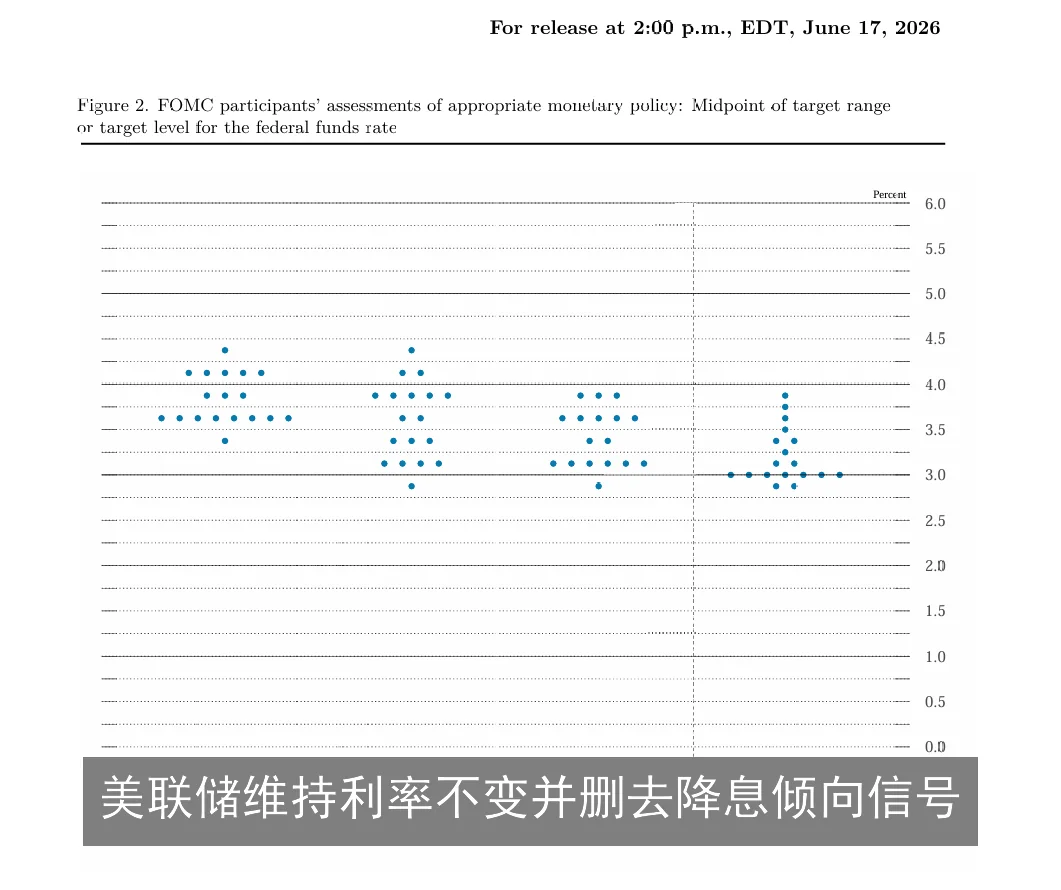
Article Summary: The Fed kept interest rates unchanged at 3.5% to 3.75% and removed language signaling a bias toward future rate cuts in the policy statement, while significantly shortening the statement. The dot plot showed rate cut expectations for this year were removed; market focused on inflation and possibility of rate hikes.
Fed Holds Rates Steady, Removes Easing Bias Signal
The first meeting chaired by new Fed Chair Kevin Warsh concluded, with the Federal Open Market Committee unanimously voting to keep the benchmark overnight lending rate range at 3.5% to 3.75% and removing key language hinting at a future bias toward rate cuts, while significantly shortening the policy statement.
The federal funds rate has remained at this level since the central bank cumulatively cut rates by 0.75 percentage points in the second half of 2025. Although the market was highly focused on Warsh's chairmanship, this meeting followed the established pattern of rate decisions so far this year.
Fed officials withdrew expectations for a rate cut this year through the closely-watched "dot plot" and hinted that a rate hike, while possible, is not a sure thing. A note attached to the projections showed that 18 of the 19 participants submitted rate and economic forecasts, leading market observers to speculate that Warsh may not have submitted his forecasts.
The dot plot is an anonymous summary of expectations, so it is impossible to confirm whether the missing submission was indeed Warsh. But before the meeting, the market widely expected he would not participate in the Summary of Economic Projections (SEP) and might even try to eliminate this mechanism. Meanwhile, one dot was also missing from the 2028 projections.
Warsh has long criticized the dot plot and the forward guidance on unemployment, inflation, and GDP in the SEP. Along with the widely anticipated rate decision, the FOMC post-meeting statement also removed earlier language hinting at a future bias toward easing and cut the remaining content significantly.
This week's statement was only 130 words, compared to 341 words after the previous meeting on April 29. The statement only offered a brief summary of economic conditions and reiterated its commitment to controlling inflation. It said that despite some uncertainty, partly due to the Middle East conflict, economic activity continues to expand at a solid pace, productivity growth and capital investment are strong, job growth keeps pace with labor force size, and the unemployment rate has changed little.
The committee added that inflation remains above the 2% target, partly due to supply shocks pushing up prices in some areas including energy, and the committee is committed to achieving price stability. The statement also noted that the Fed will maintain its policy of keeping "ample reserves" in the banking system, meaning there are currently no plans to immediately reduce bond holdings from its $6.7 trillion balance sheet.
At the previous April meeting, there were three dissenting votes as regional reserve bank presidents wanted to keep the option of either a future rate hike or cut, opposing the so-called "forward guidance" language; this statement passed unanimously.
Amid uncertainty about the rate outlook, officials also adjusted future policy guidance. The anonymous dot plot erased previous expectations for one rate cut this year and pushed any possible rate cuts to 2027 and 2028 as policymakers assess whether the inflation surge triggered by the Iran war is persistent.
The dot plot showed the median year-end federal funds rate projection at 3.8%, about 0.16 percentage points above the current level, indicating a rate hike is being considered. Officials continue to expect the long-run federal funds rate to be 3.1%.
On the economic front, officials raised their 2026 headline inflation forecast to 3.6% and core inflation to 3.3%; both were 2.7% in the March update. They also slightly lowered GDP growth expectations to 2.2% and the unemployment rate to 4.3%.
The inflation surge has put policymakers in a dilemma. Traditional policy training requires them to look through short-term supply shocks, such as war-related energy price increases. Recent inflation indicators hit multi-year highs, with the May CPI showing an annualized inflation rate of 4.2% and core inflation stripping out food and energy at 2.9%. Over the past five years, inflation has remained above the Fed's 2% target.
Although Warsh had almost no public comments before being sworn in on May 22, he has long advocated that policymakers should generally look through supply-shock inflation and believes that AI will ultimately have a deflationary impact on the economy as productivity increases help lower goods and service costs.
However, the surprisingly strong labor market complicates the case for rate cuts. May nonfarm payrolls again exceeded expectations, adding 172,000 jobs, while the unemployment rate most closely watched by the Fed has remained at 4.3% over the past year.
Market pricing aligns with the FOMC's expectations. According to the CME FedWatch Tool, markets do not expect a rate cut in 2026 and anticipate a 25-basis-point rate hike by year-end.